
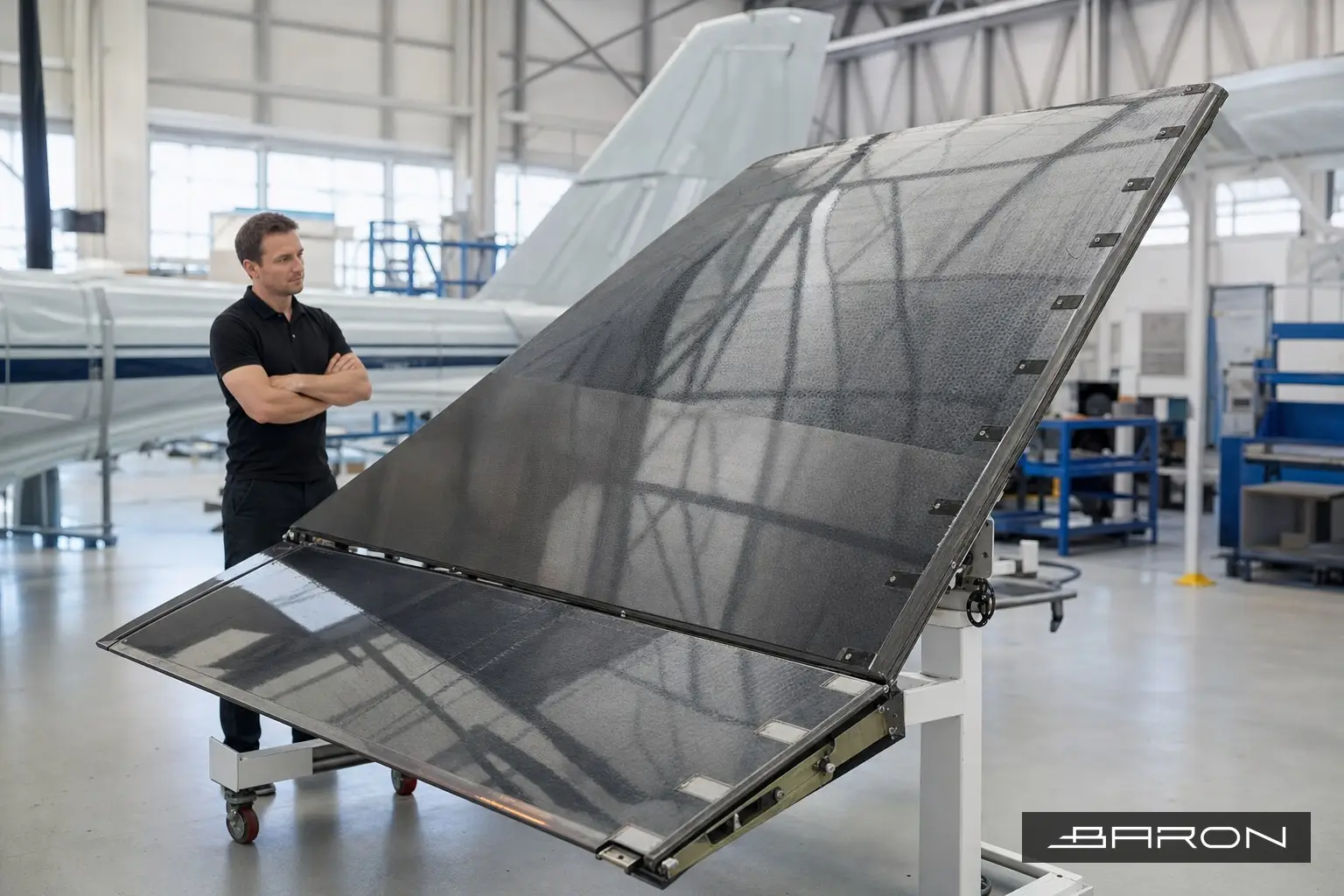
The Complete Guide to Composite and Honeycomb Inspection in Aircraft
Introduction
Composite structure is everywhere on a modern aircraft. Rudders, elevators, flaps, spoilers, radomes, fairings, engine fan cowls, nacelles, and large sections of fuselage and wing are built from carbon or fiberglass laminate, often bonded over an aluminum or Nomex honeycomb core. The parts are light and strong, but they fail in ways that metal does not. You do not get a crack you can see. You get a disbond between the skin and the core, a delamination buried a few plies down, crushed core after an impact, or water sitting inside the honeycomb cells where it freezes at altitude and tears the bond apart.
None of that shows up in a normal walkaround. That is why composite and honeycomb inspection leans so heavily on nondestructive testing. This guide walks through the methods Baron NDT uses on bonded aircraft structure, what each one finds, where it is used, and which standards govern the work. If you want the broader picture of how all of this fits into a maintenance program, start with our ultimate guide to aircraft NDT inspection.
What goes wrong in composite and honeycomb structure
Before picking a method, you have to know what you are hunting for. Composite damage falls into a handful of recognizable categories, and each one favors a different inspection approach.
Disbond
A disbond is a separation at a bonded interface, usually between the facesheet and the core, or between two laminate plies that were co-bonded. It is the classic honeycomb defect. A disbonded skin still looks perfect from the outside but no longer carries load the way the design intended. Disbonds grow under fatigue and thermal cycling, so finding them early matters.
Delamination
Delamination is a separation between plies inside a solid laminate. It often follows an impact, a lightning strike, or overheating during a repair. A delamination can sit just under the surface or deep in a thick layup, which changes how you inspect it.
Core damage and crush
Honeycomb core is fragile. A dropped tool, a misrigged clamp, or a hard landing can crush the cells flat in a small area. The skin may spring back and hide the damage, but the core underneath is gone as a load path.
Water ingress
Water is the quiet killer in honeycomb. A small breach in the skin or a failed edge seal lets moisture wick into the cells. It adds weight, corrodes aluminum core, and when it freezes at cruise altitude it expands and drives disbonds outward from the wet area. Control surfaces like rudders and elevators are notorious for it, which is why we publish dedicated work on Airbus rudder honeycomb core inspection.
Inspection methods for bonded structure
No single method catches everything. A good composite program layers two or three techniques so their blind spots do not overlap. Here is how each one earns its place.
Infrared thermography
Thermography is Baron’s primary tool for large bonded panels, and for good reason. Active thermography heats the surface with a flash or a controlled lamp, then a sensitive infrared camera watches how fast the heat flows away. A disbond, a pocket of crushed core, or trapped water changes the local cooling rate, so the defect shows up as a thermal pattern on the camera. It is fast, it covers a lot of area at once, and it does not need couplant or contact.
Flash thermography suits thin skins and shallow disbonds. Lock-in thermography, which uses a modulated heat source, reaches a little deeper and rejects surface noise. Water ingress stands out clearly because water holds heat differently than dry core. We cover the technique in depth in our guide to infrared thermography for composite inspection, and in field examples like honeycomb core damage in flight control surfaces and disbond detection in Airbus rudder bonded skins.
Tap test
The tap test is the oldest bond inspection there is, and it still has a place. A technician taps the surface with a coin or a calibrated tap hammer and listens. Solid bonded structure rings sharp and bright. A disbond or crushed core sounds dull and dead. Instrumented tap testers remove some of the guesswork by reading the contact time of each tap. It is cheap and quick for small areas, but it is operator dependent, it does not work well on thick laminates, and it tells you a bond is bad without telling you much about how deep or how large the defect is. We use it as a screening tool, not a final answer. For the tradeoffs against thermography, our maintenance teams reference the comparison work in the thermography guide above. For related guidance, see our coverage of Detecting Water Ingress in Composite Honeycomb with Thermography and Thermography vs Tap Test for Composite Bond Inspection on Aircraft.
Ultrasonic testing
Ultrasonic testing puts sound into the part and reads the echoes. On composites it is excellent for measuring how deep a delamination sits and for mapping the size of a defect. Pulse-echo works from one side and is the workhorse for laminate inspection. Through-transmission, with a transmitter on one side and a receiver on the other, is the standard for sandwich panels and is often run as a C-scan to produce a map of the whole part. Ultrasonic methods give you depth and dimension that thermography and tap testing cannot, at the cost of speed and the need for couplant or a squirter setup. See our ultimate guide to ultrasonic testing for the underlying physics.
Bond testing instruments
Dedicated bond testers use mechanical impedance or resonance to sense the stiffness of the structure under the probe, as in the ELCH bonding layer test of Airbus rudder honeycomb skins. They sit between the tap test and full ultrasonics: more repeatable than a coin, less setup than a C-scan. They are well suited to thin skin-to-core disbonds where conventional ultrasound struggles. The pitch-catch mode is forgiving on curved and thin panels, which is why it shows up so often on control surface skins.
Radiography for water and core condition
X-ray sees what the surface methods cannot. Radiography is the go-to for confirming water in honeycomb, because pooled water shows as a dense shadow against the open cells. It also reveals crushed or migrated core, node bond failures, and blocked drain paths. Film, computed radiography, and digital detectors all work on these parts. The catch is radiation safety and the need for access to both sides or a controlled area. Our radiographic testing guide covers the setup and image quality requirements.
Where composite inspection happens on the aircraft
Bonded structure is concentrated in a few zones, and each one drives recurring inspection work.
Flight control surfaces are the biggest category. Rudders, elevators, ailerons, flaps, and spoilers are mostly honeycomb sandwich, and they take impact and weather. Baron does steady volume on Airbus elevator composite panels and rudder side panels. Engine nacelles, fan cowls, and thrust reverser panels are bonded composite that also sees heat and acoustic loading, which we cover in our work on Boeing engine fan cowl thermography and nacelle thrust reverser panel inspection. Radomes, wing-to-body fairings, belly fairings, and leading and trailing edge panels round out the list. On newer airframes like the A220, A350, and 787, primary structure itself is composite, so the inspection scope keeps growing.
Standards and certifications
Composite inspection on certificated aircraft is not freelance work. It runs against published procedures and qualified people.
The controlling documents are the OEM nondestructive test manuals. Airbus publishes its NTM, Boeing its NDT manual, and each gives the exact method, equipment, reference standard, and accept or reject criteria for a given part. Airbus rudder and elevator honeycomb work, for example, traces back to specific NTM 55 chapters. The FAA’s advisory material in AC 43.13-1B gives acceptable methods and techniques for bonded structure where an OEM procedure is not called out.
Personnel are qualified to NAS 410, the aerospace standard for NDT personnel, or to an equivalent written practice built on SNT-TC-1A. A Level II runs the inspection and a Level III writes and approves the procedures and interprets the hard calls. All of this happens inside a 14 CFR Part 145 repair station quality system, which Baron holds under CRS 5NDR545D. ASTM standards back the individual methods, including E2581 for through-transmission ultrasonic of sandwich structure, E2533 for radiographic examination of polymer matrix composites, and the thermography practice E2582.
Advantages and limitations
The honest version: every method trades coverage against detail. Thermography is fast and covers large bonded areas with no contact, but it is best on shallow defects and reads less clearly through thick laminate. Tap testing is cheap and instant but operator dependent and limited to thin structure. Ultrasonics give depth and size with high confidence but are slow and need couplant. Bond testers handle thin skins well but give limited depth information. Radiography confirms water and core condition like nothing else but carries radiation safety overhead and access constraints.
That is exactly why composite inspection is a layered job. Thermography or tap testing screens the area fast, then ultrasonics or radiography characterizes anything suspect so the engineering disposition rests on real numbers, not a hunch.
Best practices
A few habits separate reliable composite inspection from the kind that misses defects:
- Match the method to the defect and the structure. Use thermography for broad disbond and water screening, ultrasonics for depth and sizing, radiography to confirm water and core condition.
- Reference a real standard. Calibrate against representative reference panels with known disbonds, not against a guess about what good looks like.
- Inspect to the OEM manual revision in effect. NTM and NDT manual procedures get revised, and the accept or reject limits can change with them.
- Watch the edges and fasteners. Water and disbonds start at edge seals, drain paths, and penetrations, so do not skip the perimeter.
- Document with maps, not just words. A C-scan or a thermal image with the defect outlined gives the repair shop something to act on.
- Re-inspect after repair. A bonded repair needs its own NDT to prove the new bond is sound.
Frequently asked questions
What is the difference between a disbond and a delamination?
A disbond is a separation at a bonded joint, usually skin to core. A delamination is a separation between plies inside a solid laminate. They look similar on some instruments but call for different repairs, so identifying which one you have matters.
Can you find water in honeycomb without cutting the part open?
Yes. Radiography is the most reliable way to confirm trapped water because it shows as a dense shadow, and thermography flags wet areas by their different cooling behavior. Both are nondestructive, so the part stays installed.
Is the tap test still acceptable on aircraft?
It is, as a screening method on thin bonded structure, and some OEM procedures still list it. It is not enough on its own for thick laminate or for sizing a defect, so it is paired with an instrumented method when the result drives a repair.
Which method is best for composite inspection?
There is no single best method. Thermography covers large areas fast, ultrasonics give depth and size, radiography confirms water and core damage. A sound program uses two or more so their weaknesses do not line up.
Who is qualified to inspect aircraft composites?
NDT personnel qualified to NAS 410 or an equivalent written practice, working inside a Part 145 repair station quality system, with a Level III approving the procedures and interpreting borderline results.
Conclusion
Composite and honeycomb structure keeps aircraft light, but it hides its damage. Disbonds, delaminations, crushed core, and trapped water all stay invisible until the right NDT method brings them out. Getting it right means choosing the method for the defect, calibrating to a real standard, and inspecting to the current OEM procedure under a qualified Level III.
Baron NDT is an FAA Part 145 repair station and SDVOSB with deep experience in bonded aircraft structure, from Airbus rudders and elevators to Boeing fan cowls and nacelles. We run thermography, bond testing, ultrasonics, and radiography on composite parts every week. If you have honeycomb or laminate structure that needs an answer, call us at 904-304-2907 or reach out through baronndt.com and we will help you scope the inspection.