
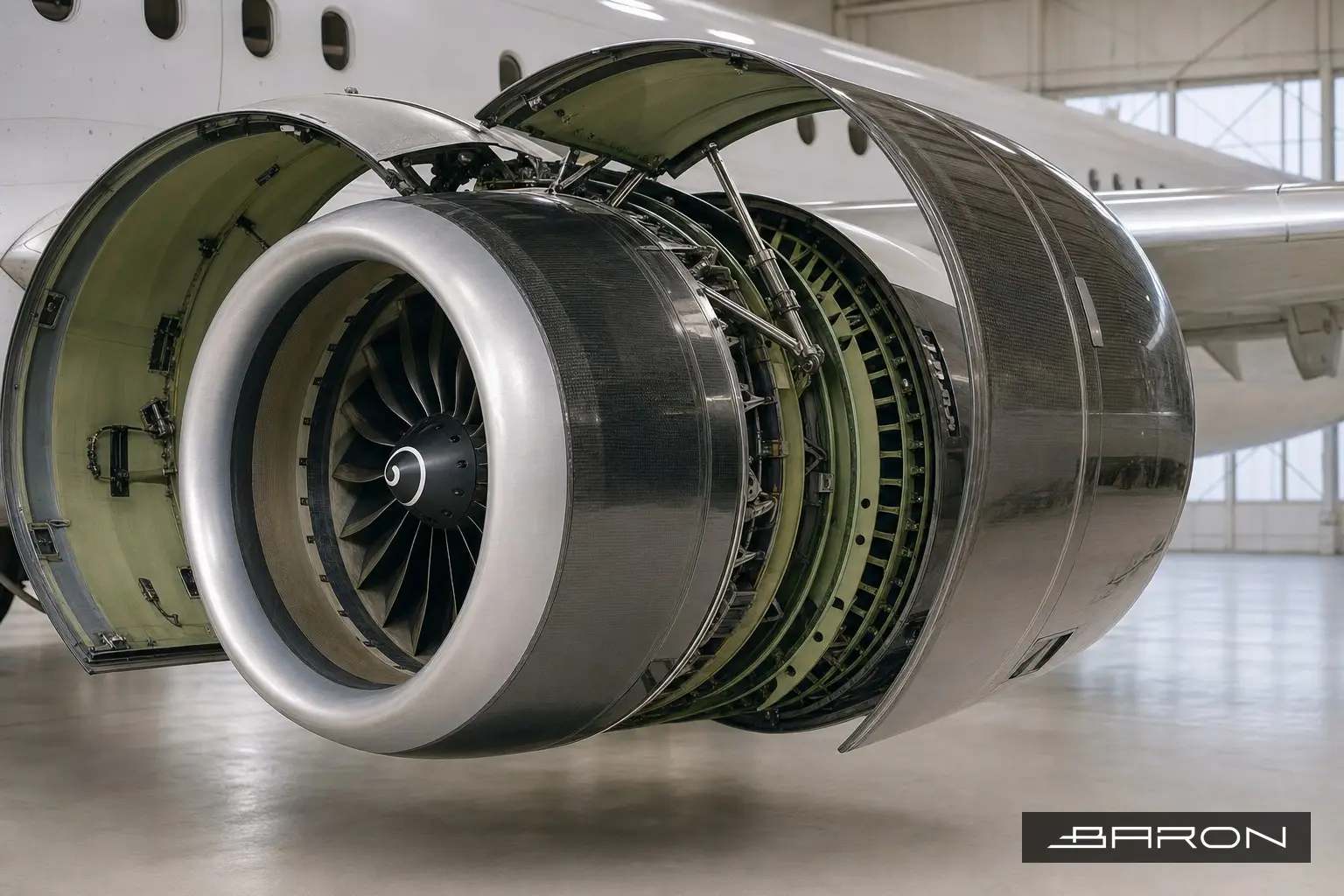
The fan cowl is one of the busiest pieces of composite on a Boeing narrowbody. It takes acoustic load, vibration, ramp impact, runway debris, and the occasional dropped tool. Underneath the painted carbon skin sits a thin sandwich: two CFRP face sheets bonded to a Nomex honeycomb core. When that bond lets go, or when water works its way into the core, the panel looks fine from the outside and fails on the inside. Infrared thermography is the method that sees the difference.
This is one of the inspections Baron NDT runs most often on the composite side of a shop visit. It sits within our broader composite and honeycomb inspection work and the full aircraft NDT inspection scope a shop visit can call for. Here is how we approach it and what the camera actually shows.
What we are looking for in a fan cowl
Three defect types drive the inspection. The first is disbond, where the face sheet separates from the honeycomb core. The second is delamination inside the laminate itself, usually from impact. The third is water ingress, where moisture collects in the cells of the core through a crack, a worn seal, or a fastener hole that lost its sealant. Water is the quiet one. It adds weight, freezes at altitude, and breaks down the adhesive over time, so a small intrusion becomes a large disbond a few cycles later.
Tap testing will find a gross disbond near the surface, but it gets unreliable on thicker layups and tells you nothing useful about how far the damage runs. That is where active thermography earns its place.
How active thermography sees subsurface damage
Active thermography heats the surface with a short, controlled pulse, usually from a flash lamp, then watches how the heat drains away. Sound structure conducts heat into the core evenly. Over a disbond or a pocket of water, the heat flow changes. Air gaps hold heat at the surface and show up warm. Trapped water pulls heat away and shows up cool. The camera records that transient, and the operator reads the contrast frame by frame as the surface cools.
For fan cowls we lean on flash thermography for fast, full-panel coverage and switch to lock-in when a specific area needs depth information or a cleaner signal on a noisy layup. The big advantage over point methods is area coverage. One flash sequence inspects a square foot or more in seconds, with no couplant and no contact, which matters on a painted exterior surface you do not want to disturb.
If you want the longer view on the physics and the difference between active and passive setups, our overview of thermography in modern NDT walks through it, and our complete guide to infrared thermography for composite inspection covers the flash and lock-in methods end to end. The same flash and lock-in techniques we use on Airbus control surfaces apply directly to Boeing nacelle composites.
Procedure, references, and acceptance
The work is done to the operator’s approved SRM and NDT manual callout for the specific cowl, with infrared thermography accepted under the general guidance in FAA AC 43.13-1B for bonded composite structure. Personnel are qualified and certified to NAS 410, and the procedure spells out flash energy, standoff distance, frame rate, and the post-processing applied to the thermal sequence.
Calibration is done against a reference standard with known disbonds and embedded defects at representative depths, so the operator can confirm the system resolves the smallest reportable indication before touching the part. Every indication gets mapped to the panel, sized, and recorded against the acceptance limits in the manual. Anything outside limits goes back to engineering for disposition. We document the thermal images, not just a pass or fail line, so the repair station and the operator have a record they can compare against the next inspection.
Where fan cowl thermography fits in a shop visit
Fan cowls usually come off during a heavy check or an engine change, which is the right time to inspect them on a bench under controlled lighting and temperature, and this composite check runs alongside the metallic and internal hardware work covered in our guide to NDT in aircraft engine and MRO. Cold-soaked panels and direct sun both wreck thermal contrast, so a stable shop environment beats a ramp inspection every time.
The cowl is rarely the only composite in the work scope. The same crew and the same camera handle nacelle and thrust reverser panels, fairings, and flight control surfaces in the same visit. Thermography pairs well with the eddy current and ultrasonic work happening elsewhere on the airframe, the way eddy current array on 737 crown skin covers the metallic structure while thermography covers the bonded composite. For shops weighing whether to keep this in house or send it out, our piece on outsourcing NDT in aviation MRO lays out the tradeoffs.
Baron NDT performs composite thermography as an FAA Part 145 repair station with Boeing Conformity Review approval. If you have fan cowls, nacelle panels, or flight control surfaces with suspected disbond or water in the core, that is exactly the work this method was built for. You can see the same approach applied to bonded skins in our writeup on disbond detection in Airbus rudder bonded skins.