
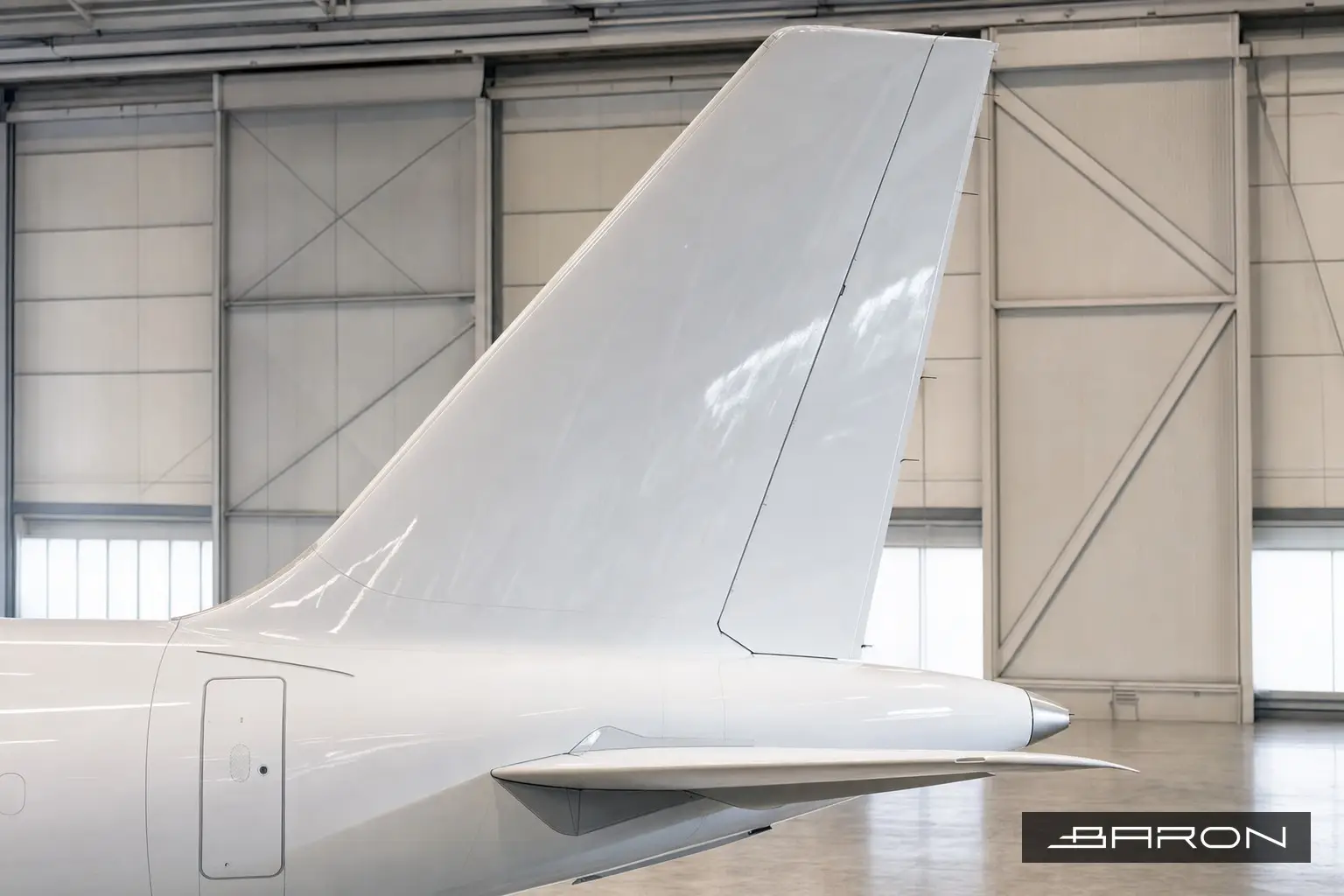
A bonded rudder side panel is a thin composite or aluminum facesheet adhered to a honeycomb core. When the adhesive between the facesheet and the core lets go, you have a disbond. The skin is no longer carrying load into the core the way the design intended, and from the outside the panel can look perfect. That is the whole problem with disbonds. They hide.
On the Airbus rudder side panels covered by NTM 55-40-08, this is a recurring finding. It is one of the classic composite and honeycomb inspection tasks inside a full aircraft NDT inspection program. Baron NDT inspects these surfaces with infrared thermography, and the method earns its place because of how fast and how completely it covers a large bonded area.
Why disbonds form in the first place
Most of what we find traces back to one of a few causes. Water ingress into the core, usually through a damaged edge seal or a fastener path, freezes at altitude and works the bond loose over many cycles. Impact from ground handling or hail crushes core cells and breaks the adhesive fillet without leaving an obvious dent. And ordinary fatigue near attachment fittings slowly separates the skin from the core. A disbond and a wet core often travel together, which matters for how we read the thermal data.
How thermography sees what the eye cannot
The physics is straightforward. A good skin-to-core bond conducts heat away from the surface in a predictable, even way. A disbond is an air gap, and air is a poor conductor. So when you put a controlled pulse of heat onto the panel and watch it cool with an infrared camera, the area over a disbond holds heat longer and shows up as a warm spot against the surrounding sound structure.
Baron uses flash thermography for this. A pair of high-output flash lamps deposits a short, even thermal pulse across the panel, and the camera records the surface temperature decay frame by frame. The defect signature does not always jump out of a single raw frame, so we process the sequence. Thermal signal reconstruction and second-derivative imaging pull the disbond contrast out of the cooling curve and suppress the surface clutter from paint and lighting. Water in the core reads differently from a dry air gap because of its higher heat capacity, so the processed sequence helps separate a wet core from a clean disbond. Our complete guide to infrared thermography for composite inspection walks through flash and lock-in setups in detail.
Where thermography beats the tap test
Tap testing still has its place, and a trained ear with a coin or a tap hammer can confirm a suspect spot. But on a full rudder side panel the tap test is slow, it is operator dependent, and it gives you a point reading rather than a map. Thermography images the entire panel in one shot. A single flash sequence covers a square foot or more of bonded area and produces a record you can measure, archive, and hand to engineering. On thin facesheets over honeycomb, that area coverage is the difference between catching a disbond and walking past it.
The guidance for these inspections is grounded in the Airbus NTM and in AC 43.13-1B for general bonded structure evaluation. ASTM E2582 is the standard practice for flash thermography of composite panels and frames how we set up the shot and judge the result. Personnel are qualified to NAS 410, and the infrared thermography method (IRT) is one of the eleven methods on Baron’s FAA Part 145 repair station scope under CRS 5NDR545D. Thermography also crosses over into industrial work, as we cover in the role of Airbus thermography in modern industrial NDT.
What the inspection actually looks like
We start by cleaning the surface and noting any paint condition that could affect emissivity. The flash head and camera are set at a fixed standoff so the heating is even across the field of view. We capture a reference on a known sound area of the same panel, then work the surface in overlapping shots so nothing falls between frames. Suspect indications get sized against the cooling curve and, where access allows, confirmed with a follow-up tap or a second method. Everything goes into the report with the thermal images, the indication map, and the call against the NTM limits.
The bottom line for operators and MROs
A disbonded rudder panel is not always grounds for replacement, but you cannot make that call until you know the size and location of the separation. Thermography gives you that picture quickly, without touching a probe to every square inch, and without removing the panel. For an MRO trying to turn a flight control surface inside a tight check window, that speed is real money. For Baron, it is one of the inspections we do most often, and the rudder side panel is where it shows its value best.
Baron NDT performs infrared thermography on Airbus rudders, elevators, engine cowls, and other bonded structure at our Jacksonville Part 145 facility. For the related core inspection, see our work on thermographic inspection of Airbus rudder honeycomb core, and for the broader method our complete guide to thermography on Airbus rudders. If you have a panel with a suspect area or a recurring wet core, call 904-304-2907.