
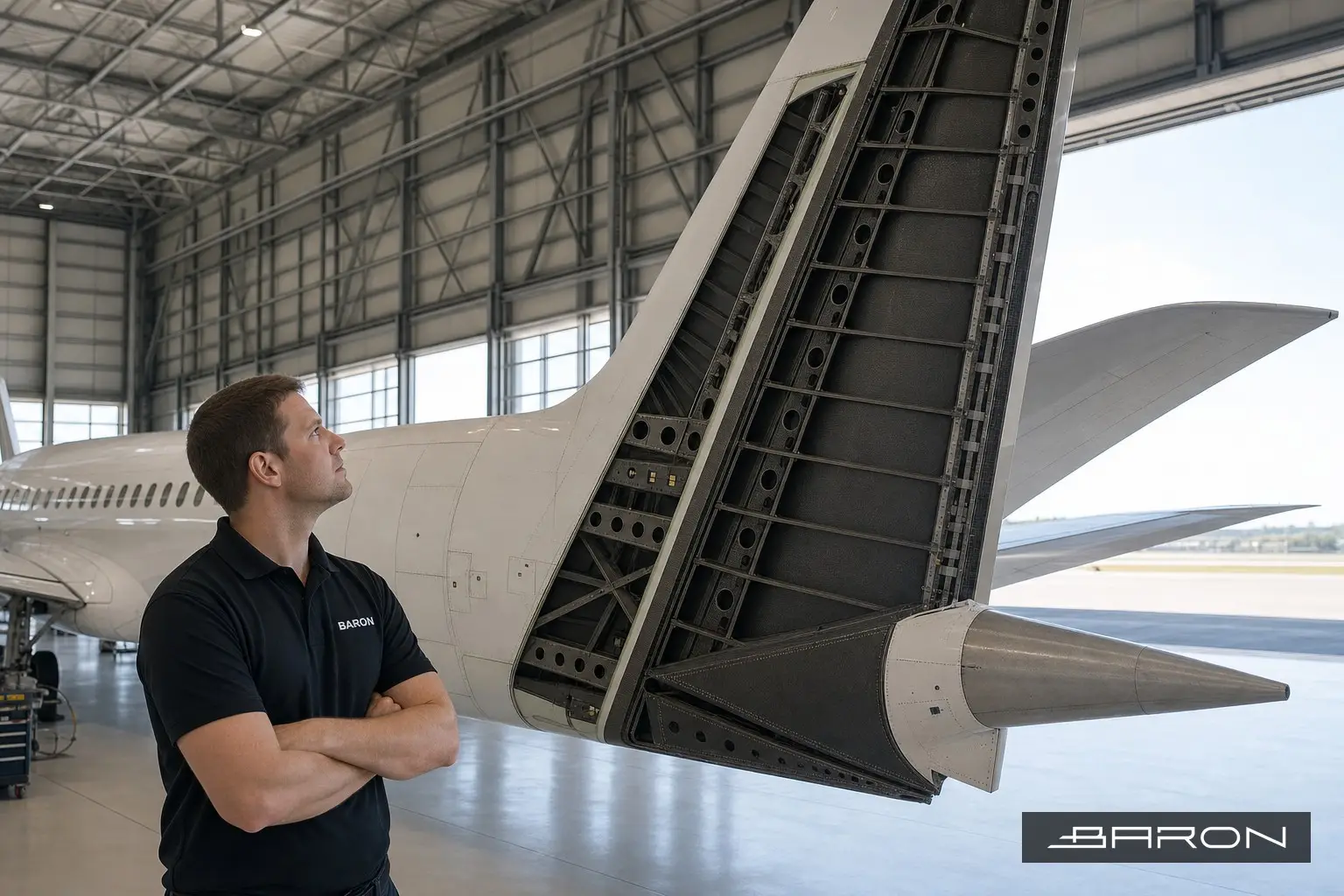
The Complete Guide to Infrared Thermography for Composite Inspection
Introduction
Composite and honeycomb structures changed how aircraft are built. They also changed how those structures fail. A bonded skin does not crack the way an aluminum sheet does. It disbonds, it delaminates, it takes on water through a cracked edge, and most of that damage hides under a surface that still looks fine. That is the problem infrared thermography solves. It reads the heat flow through a part and turns it into a picture of what is happening below the surface.
This guide covers infrared thermography for composite inspection from the ground up: how it works, the difference between active and passive methods, the flash and lock-in techniques Baron uses every week on flight control surfaces, the damage types it catches, the standards that govern it, and where it earns its keep against older methods like the tap test. It is written for engineers, quality managers, and maintenance planners who need to know when thermography is the right call and what it can and cannot do. For bonded structure specifically, see our complete guide to composite and honeycomb inspection in aircraft.
How Infrared Thermography Works
Every object above absolute zero radiates infrared energy. An infrared camera measures that radiation and maps it to temperature. On a sound composite part, heat moves through the material in a smooth, predictable way. We apply this on real structure, for example our thermographic inspection of Airbus rudder side panel honeycomb core, which fits inside the broader aircraft NDT inspection workload. Where there is a defect, a disbond, a delamination, a pocket of trapped water, the heat flow changes. A void slows conduction and shows up as a warm or cool spot depending on how you set the test up. The camera sees the surface, but the surface temperature pattern reports on what is underneath.
The key idea is contrast. A static thermal image of a part sitting at room temperature usually tells you very little. You need a thermal gradient, a reason for heat to move, before defects reveal themselves. How you create that gradient is what separates the two main families of thermography.
Passive thermography
Passive thermography uses the heat that is already there. No external heat source is applied. You look at a part that is already at a different temperature than its surroundings, for example a structure warmed by sun or by operation, and read the natural pattern. Water ingress in a honeycomb panel often shows up passively because water has a very different thermal mass than the surrounding cells. Passive work is fast and simple, but it depends on conditions you do not fully control, so it is usually a screening tool rather than a final answer.
Active thermography
Active thermography applies a controlled heat pulse and watches how the surface responds over time. This is the workhorse for aircraft composites because you control the energy, the timing, and the analysis. The two methods that matter most are flash thermography and lock-in thermography.
Active Thermography Techniques
Flash thermography
Flash thermography fires a short, high-intensity pulse of light, usually from xenon flash lamps, at the part surface. The surface heats almost instantly, then cools as the heat diffuses inward. A high-speed infrared camera records the cooldown frame by frame. Over a sound area, the surface cools evenly. Over a disbond or delamination, the trapped air slows the heat from moving away from the surface, so that spot stays hotter longer and stands out in the thermal sequence.
Flash is fast, covers a decent area per shot, and is well suited to thin skins and near-surface defects. The deeper the defect, the harder it is to resolve, because heat spreads sideways as it travels down and the contrast blurs. For most bonded skins and honeycomb face sheets on flight controls, flash sits in the sweet spot.
Lock-in thermography
Lock-in thermography uses a periodic heat input, a sine-modulated lamp or sometimes ultrasonic excitation, instead of a single pulse. The camera locks onto that excitation frequency and extracts the amplitude and phase of the thermal response. Phase images are powerful because they suppress surface noise like uneven paint or emissivity differences and pull out subsurface features that amplitude images miss. By tuning the modulation frequency you control inspection depth: lower frequencies probe deeper, higher frequencies resolve shallow features more sharply. Lock-in trades speed for depth control and signal quality, which makes it the choice for thicker laminates and trickier bond lines. For related guidance, see our coverage of Nacelle Composite Thermography: Inspecting Thrust Reverser Panels for Disbond and Water Ingress and ELCH Bonding Layer Test of Airbus Rudder Honeycomb Skins.
What Thermography Detects in Composites
Disbond
A disbond is a separation at a bond line, between a face sheet and the honeycomb core, or between bonded skin layers. It is one of the defects thermography reads best, because the air gap is a strong thermal barrier. Baron uses active thermography to map disbonds on bonded control surfaces, and the technique has become a core part of the shop’s composite work. For a deeper look at one application, see thermography for disbond detection in Airbus rudder bonded skins.
Delamination
Delamination is separation between plies inside a laminate, often from an impact that leaves little or no visible surface mark. The internal void interrupts heat flow the same way a disbond does. Flash thermography is effective on the near-surface delaminations that follow ramp strikes, hail, or tool drops on thin skins.
Water ingress in honeycomb core
Honeycomb panels are sealed cells. When an edge seal or a fastener hole lets water in, the cells fill and the part gains weight, loses strength, and can suffer freeze-thaw damage at altitude. Water has high thermal mass, so it heats and cools differently than dry cells and shows up clearly in a thermal image. This is one of the highest-value uses of the method on a fleet, because water damage is common, invisible from outside, and expensive if it is missed. Baron inspects honeycomb core on rudders, elevators, and cowls for exactly this, and we walk through the technique in detecting water ingress in composite honeycomb with thermography. See thermographic inspection of Airbus rudder side panel honeycomb core and engine fan cowl thermography on Boeing composite panels.
Core crush and node separation
Crushed core and separated honeycomb nodes change the local conduction path and can be picked up thermally, especially with lock-in phase imaging. These defects often pair with disbonds, so a single thermal scan frequently flags more than one issue in the same area.
Applications
Infrared thermography earns most of its hours on aircraft flight control surfaces and composite secondary structure. Typical work includes:
- Rudders and elevators with bonded honeycomb skins, on Airbus and Boeing types. See the thermographic inspection of Airbus elevator composite panels.
- Engine fan cowls, nacelle panels, and thrust reverser composite structure.
- Spoilers, ailerons, flaps, and other secondary control surfaces.
- Radomes and fairings where bond integrity and water ingress matter.
- Post-repair verification on bonded composite repairs, confirming the new bond is sound before the part goes back on the aircraft.
Outside aviation, thermography also serves wind turbine blade inspection, composite pressure vessels, and bonded automotive and marine structures, but the aircraft composite world is where it is most established and most demanding.
Standards and Certifications
Thermography on aircraft is not freelance work. It follows OEM procedures and recognized standards, performed by certified personnel under a documented written practice.
- OEM NDT manuals. The controlling documents are the airframe manufacturer’s Nondestructive Testing Manual procedures. Airbus structural repair and NTM thermography procedures and the equivalent Boeing NTM sections define the technique, the equipment class, the acceptance criteria, and the reference standards for each specific part.
- FAA Advisory Circular AC 43.13-1B. Provides acceptable methods for inspection and repair of aircraft structure, including guidance relevant to composite and bonded structure inspection.
- ASTM standards. ASTM E2582 covers flash thermography of composite panels, and ASTM E1934 gives the general guide for inspecting electrical and mechanical equipment with infrared thermography. These frame the technique and the equipment performance expectations.
- NAS 410. The National Aerospace Standard for NDT personnel qualification and certification. Aerospace thermographers are qualified to NAS 410, which sets training hours, experience, and examination requirements by level.
- SNT-TC-1A. The ASNT recommended practice that underpins many employer written practices for personnel certification across NDT methods, including infrared and thermal testing.
- 14 CFR Part 145. Work performed at a certificated repair station is done under the station’s quality system and FAA repair station authority. Baron NDT holds FAA Part 145 certification (CRS 5NDR545D), so thermography is delivered with the records and traceability the regulation requires.
Advantages and Limitations
Thermography is the right tool for a specific class of problems. It is not a universal replacement for other methods, and it sits alongside the rest of the toolkit covered in our ultimate guide to nondestructive testing.
Advantages
- Non-contact and full-field. A single shot inspects a wide area at once, far faster than point-by-point methods.
- Excellent on the exact defects composites suffer: disbond, delamination, and water ingress.
- No couplant, no consumables on the part, no surface damage.
- Results are visual and easy to document, which helps with reporting and disposition.
- Works through paint and on complex contoured surfaces where contact scanning is awkward.
Limitations
- Depth is limited. Deeper defects lose contrast as heat spreads laterally, so very thick laminates are challenging.
- It does not sizing-measure the way ultrasonics can; it is strongest at finding and mapping, and often pairs with UT for through-thickness detail.
- Emissivity, surface finish, and ambient conditions affect results and must be controlled.
- It needs a trained interpreter. The raw thermal sequence is data, not a verdict, and reading it well takes experience.
- Equipment cost and procedure development are higher than for a tap hammer or basic PT setup.
Best Practices
- Match the technique to the part. Use flash for thin skins and near-surface defects; reach for lock-in when you need depth control or cleaner phase data on thicker laminates.
- Control the surface. Confirm emissivity, watch for reflective spots, and shield the area from drafts and stray heat sources that corrupt the thermal gradient.
- Use reference standards. Calibrate against representative standards with known defects so contrast and acceptance criteria are anchored to something real.
- Follow the OEM procedure for the specific part. Acceptance limits and technique details are part-specific and live in the NTM, not in general practice.
- Confirm and cross-check. When a thermal indication is borderline or critical, verify with a second method such as ultrasonics before disposition.
- Document the full sequence. Save the thermal data, the setup parameters, and the analysis so the result is traceable and repeatable.
- Use qualified personnel. NAS 410 qualification is not a formality; interpretation quality is the method’s biggest variable.
Frequently Asked Questions
Is infrared thermography better than a tap test for composite bonds?
For most production inspections, yes. A tap test relies on the operator’s ear and only checks one spot at a time, which makes it slow and subjective on large panels. Thermography images a whole area at once, finds water ingress that tapping cannot reliably hear, and produces a permanent record. Tap testing still has a place as a quick field check, but it is not a substitute for an instrumented thermal scan on critical structure.
Can thermography find water inside honeycomb panels?
Yes, and it is one of its strongest applications. Trapped water has a much higher thermal mass than dry honeycomb cells, so it heats and cools differently and shows up clearly in the thermal image. This is a major reason operators use thermography on rudders, elevators, and cowls where water ingress is a recurring problem.
How deep can thermography see into a composite?
It depends on the technique and the material, but practical depth for active thermography on aircraft composites is roughly on the order of a few millimeters for clear results. Heat spreads sideways as it diffuses inward, so contrast fades with depth. Lock-in thermography reaches deeper than flash by lowering the modulation frequency, at the cost of inspection speed. For thick sections or precise through-thickness sizing, ultrasonic testing is the better partner.
Does the aircraft have to be taken apart for thermography?
Often not. Thermography is non-contact and full-field, so many panels and control surfaces can be inspected in place or with minimal removal. That is part of its value: it reduces downtime compared with methods that need extensive access or surface preparation.
Who is qualified to perform aircraft thermography?
Personnel qualified to NAS 410 under a documented written practice, working to the OEM NDT manual procedure for the specific part. At a Part 145 repair station the work is also covered by the station’s quality system and FAA authority, which is what makes the results acceptable for return-to-service decisions.
Conclusion
Infrared thermography is the method that matches the way composites actually fail. It finds disbonds, delaminations, and water ingress quickly, without contact, and with a clear visual record, which is exactly what bonded honeycomb structure demands. Used well, with the right technique, a controlled setup, and a qualified interpreter, it catches the damage that hides under a surface that still looks perfect.
Baron NDT performs thermographic inspection on Airbus and Boeing flight control surfaces, honeycomb panels, engine cowls, and composite repairs as an FAA Part 145 repair station (CRS 5NDR545D) with Boeing Conformity Review approval. If you have composite or honeycomb structure that needs thermography, or you are deciding whether thermography or ultrasonics is the right method for a job, contact Baron NDT at 904-304-2907 to talk it through with a Level III.