
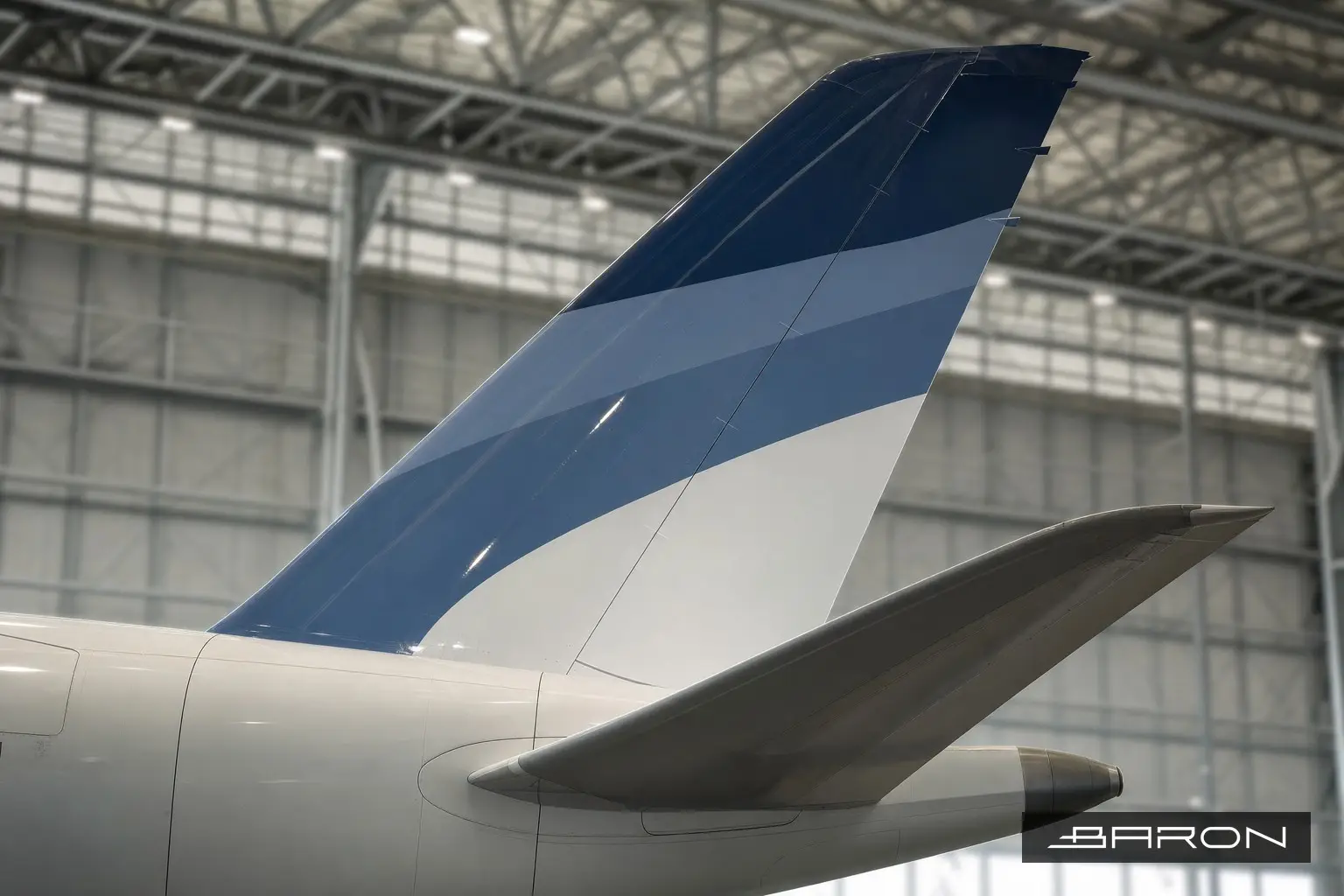
An Airbus rudder side panel looks solid from the outside, but it is a sandwich. Thin composite or aluminum skins are bonded to a lightweight honeycomb core, and that bond is the whole point of the structure. When the bond fails, when the skin separates from the core or the core crushes or takes on water, the panel loses the strength it was designed to carry. The hard part is that none of that shows on the surface. Thermographic inspection is how you see it without taking the rudder apart.
Baron NDT performs this inspection on Airbus rudder honeycomb structure using the thermographic procedure called out in the Airbus NDT manual, NTM 55-40-08. It is one of the cleaner examples of why thermography exists. For the method from the ground up, see our complete guide to infrared thermography for composite inspection.
Why honeycomb panels fail where you cannot see
Honeycomb sandwich construction gives you a stiff, light panel by separating two thin skins with a cellular core. Inspecting it is core composite and honeycomb inspection work, one piece of the broader aircraft NDT inspection picture. It works beautifully until something breaks the bond. Impact damage, moisture ingress, freeze-thaw cycling, and manufacturing defects all attack the skin-to-core bond. A disbond is a spot where the skin is no longer attached to the core. Water in the cells adds weight and drives further damage every time the airplane climbs to altitude and the trapped moisture freezes. From outside, a disbonded panel and a healthy panel look identical. That is the inspection problem in one sentence.
How thermography sees a disbond
Thermography works on heat flow. When you warm the surface of a healthy panel, heat conducts away into the core evenly. Where there is a disbond or a pocket of water, the heat does not flow the same way. A disbond traps heat at the surface because the air gap is a poor conductor, so that spot stays warmer and shows up bright on the infrared camera. Water-filled cells behave differently again because water stores heat. The inspector applies a controlled thermal pulse to the panel and watches the surface temperature with an infrared camera as the heat dissipates. The defects reveal themselves as the surface cools, because they change the cooling pattern.
- Full-field. The camera sees the whole panel at once, not one point at a time. A single capture covers a large area of the rudder.
- No couplant, no contact. Thermography is done from a standoff, so there is nothing to drag across the surface and nothing to clean off after.
- Fast. A large flight control surface can be screened quickly, which matters when the airplane is on a turnaround.
- Imaged and documented. The result is a thermal image, easy to interpret and easy to put in a report.
How the inspection runs
The work follows NTM 55-40-08 for the rudder side panel honeycomb core. In general terms, the inspector cleans and prepares the panel, sets up the thermal source and the infrared camera at the correct standoff, and captures the heating and cooling sequence across the side panel, left hand and right hand. The thermal sequence is evaluated for the signatures of disbond, core damage, and water ingress against the accept and reject criteria in the procedure. Indications are mapped to the panel location, sized, and dispositioned. On some rudders the thermographic inspection is paired with a bonding-layer test, the ELCH test, to confirm the integrity of the bond between the honeycomb structure and the external skins.
The inspection is performed by certified Level II or Level III thermography personnel qualified under a written practice that meets NAS 410. Thermography is a method that rewards experience, because reading the thermal sequence correctly and separating a real defect from a surface or geometry artifact is where the skill lives. The same method carries over to other sectors, as we discuss in Airbus thermography in modern industrial NDT.
What operators should expect
This is composite bond inspection on a primary flight control surface, so the priorities are full coverage of the panel, correct interpretation, and clean documentation that holds up to an audit. Done right, thermography screens the whole rudder fast and finds the disbonds and core damage that a visual check will always miss. Baron NDT performs thermographic inspection of Airbus rudder honeycomb side panels, along with elevator panels, engine cowls, and other composite structure, with the certifications and the equipment to do it and document it for the record. This pairs closely with our thermography for disbond detection in Airbus rudder bonded skins and the broader guide to thermography on Airbus rudders.
If you have an Airbus rudder or other composite flight control surface coming due for inspection, that is exactly the work we do. Contact Baron NDT and we will get it scheduled.