
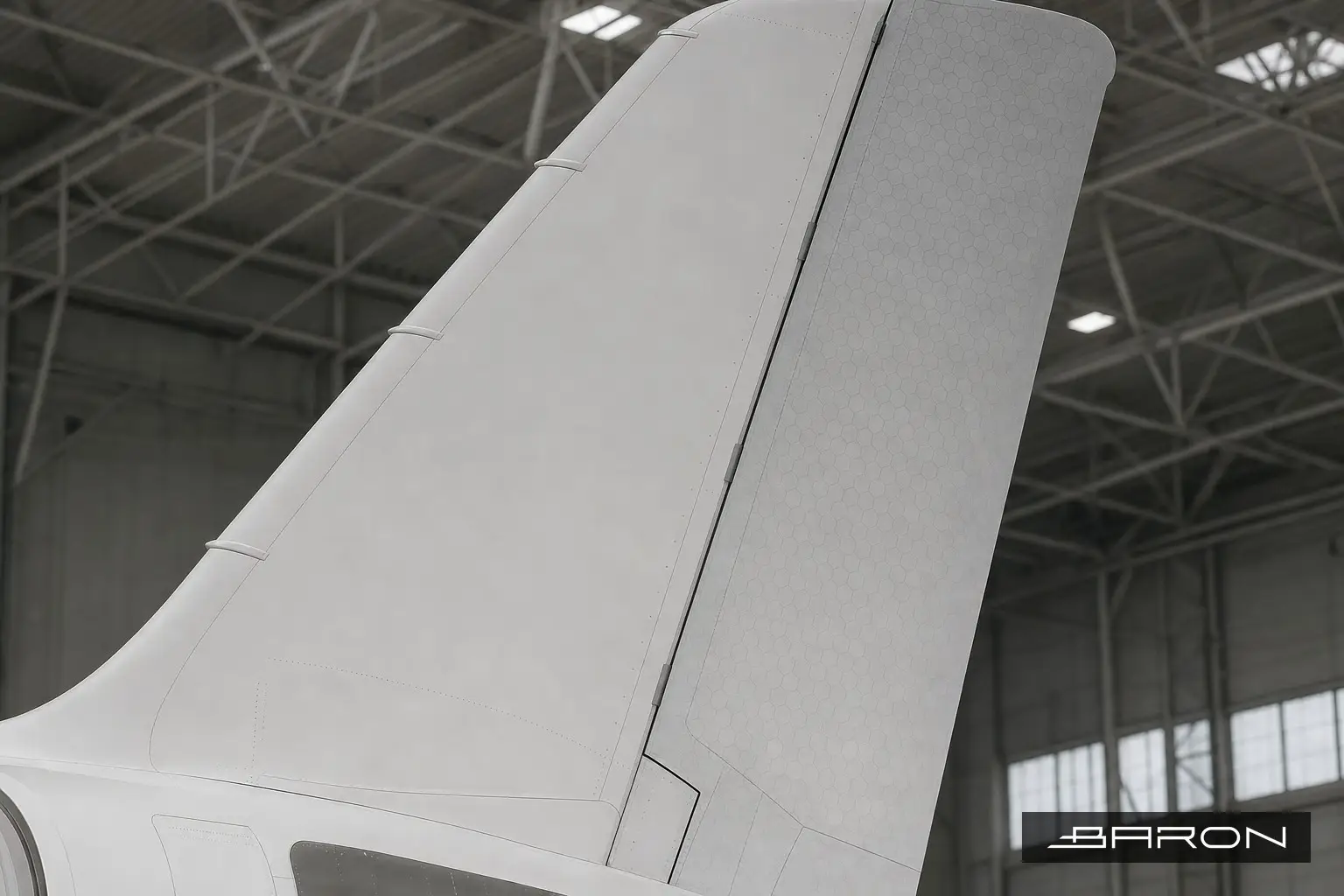
The rudder side panels on most Airbus narrowbodies are bonded honeycomb sandwich: thin composite or aluminum face sheets adhesively bonded to a Nomex or aluminum core. When that adhesive bondline lets go, the skin loses the core support that keeps it stable in flight loads, and the defect rarely shows on the surface. The ELCH bonding layer test is the Airbus-approved way to find those skin-to-core disbonds before they grow into something you can see.
At Baron NDT we run this inspection as part of scheduled rudder checks and after impact or lightning events. Here is how the method works, what it actually detects, and where it fits alongside the other tools we use on bonded control surfaces.
What the ELCH test is looking for
ELCH is a bond-integrity test built around mechanical impedance. The probe couples low-frequency vibration into the skin and reads how the structure pushes back. Over a well-bonded area the core stiffens the skin and the impedance reading sits in a tight band. Move the probe over a disbond and the unsupported skin behaves like a small drum: the local stiffness drops, the impedance signal shifts, and the instrument flags it. The technique is sensitive to the condition of the bonding layer itself, which is why Airbus references it for honeycomb skin verification rather than a generic flaw scan.
The defects that matter on a rudder side panel are skin-to-core disbond, adhesive voids from the original lay-up, crushed or fractured core under prior impact, and core that has corroded or softened after water ingress. ELCH responds to all of these because every one of them removes the stiffness the core is supposed to provide to the face sheet.
Procedure and reference standards
The work is driven by the Airbus Nondestructive Testing Manual, with rudder honeycomb skin inspection covered under the 55-40 task set (the same NTM family that governs the broader rudder side panel honeycomb core inspection). Personnel are qualified to NAS 410, and the inspection is performed under our FAA Part 145 repair station quality system so the records hold up on a return-to-service.
Setup starts on a reference standard that matches the panel: same skin material, same skin thickness, same core. We set the instrument so a known good zone reads in its nominal band and a manufactured disbond in the standard produces a clear, repeatable alarm. From there the technician indexes the probe across the panel in a controlled pattern, holding consistent contact and speed so the impedance baseline does not drift. Skin thickness changes, ply drop-offs, internal doublers, and closeout members all change the baseline, so the inspector has to know the panel construction and not chase normal structural features as if they were defects. Anything that breaks the established band gets marked, re-scanned, and sized against the standard.
Where ELCH fits with thermography and tap test
No single method owns bonded honeycomb. ELCH is strong on the bondline and gives a clean go/no-go on skin-to-core integrity, but it reads one footprint at a time. Infrared thermography covers a whole panel fast and maps the shape of a disbond or a pocket of trapped water, which is why we lean on it for area screening (see thermography for disbond detection in Airbus rudder bonded skins and the broader case for finding water ingress in honeycomb). The old coin-tap check still has a place for a quick spot confirmation, though it is operator-dependent and shallow, which we cover in thermography versus tap test.
In practice we often screen the panel with thermography, then confirm and size the flagged areas with the ELCH bonding layer test. Thermography tells you where to look and roughly how big; ELCH tells you whether the bond is actually gone at that spot. Used together they give a defensible call on a flight control surface instead of a guess.
Why the bondline call matters
A rudder side panel that has lost its skin-to-core bond is carrying load in a way it was never designed to. Left alone the disbond grows under buffet and pressure cycling until the face sheet wrinkles or fails. Catching it at the bonding layer, while it is still small, is the whole point of the inspection. That is also why the method selection, the reference standard, and the records all have to be right, not just the scan.
Baron NDT runs bond testing on bonded honeycomb across Airbus and Boeing control surfaces out of our Jacksonville FAA Part 145 station. For the full picture of how these methods stack up on sandwich structure, see our guide to composite and honeycomb inspection in aircraft, and for how bonded-surface work fits the larger airframe program, the ultimate guide to aircraft NDT inspection.