
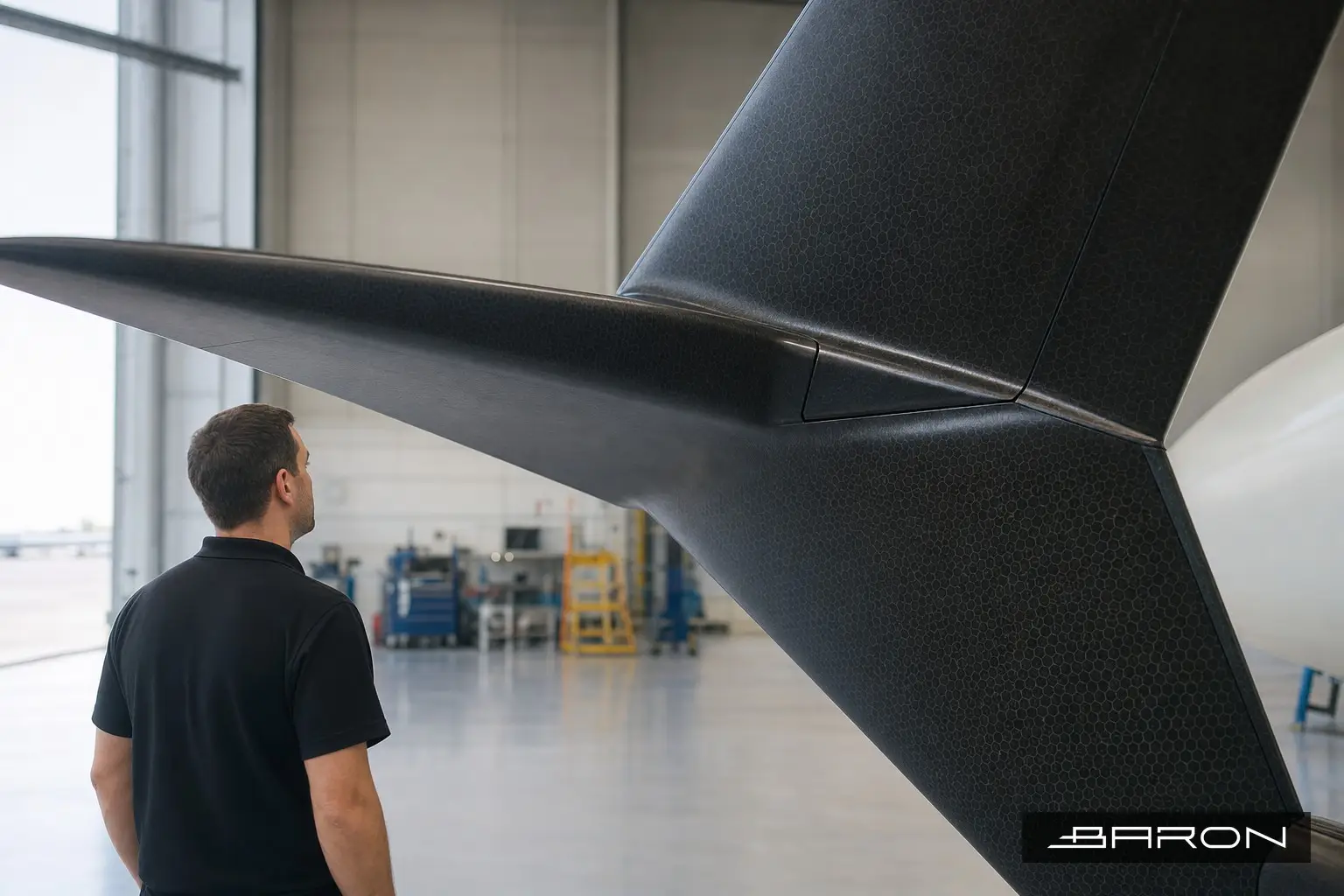
Anyone who has worked a hangar floor knows the sound. A coin or a tap hammer ringing across a composite rudder, the tone going from a crisp click to a dull thud where the skin has let go of the core. The tap test has been finding disbonds on aircraft for decades, and it still works. The question Baron NDT gets from MRO planners is whether it should still be the first tool out of the bag, or whether infrared thermography has earned that spot. The honest answer is that both have a place, and a good Level III decides based on the structure, the defect, and the records the customer needs.
What the tap test actually measures
A coin tap, or an instrumented tap hammer like a Wichitech RD3 or a Mitsui Woodpecker, excites a small area of the laminate and reads the local stiffness through the contact time of the impact. Over a sound bond the skin is stiff, the tap is short, and the tone is high. Over a disbond or a crushed honeycomb cell the skin flexes more, the contact lasts longer, and the tone drops. AC 43.13-1B recognizes the coin tap as an acceptable method for thin-skin sandwich structure, and many OEM NTM procedures still list it for first-pass screening of flight control surfaces.
The limits show up fast. Tap testing is a point-by-point method, so coverage of a full Airbus rudder or elevator is slow and depends heavily on the inspector keeping a tight grid. It loses sensitivity as skin thickness grows past a few plies because the stiffness change at depth no longer reaches the surface. It tells you a bond is bad but says little about why, so a disbond, a delamination, and water-soaked core can all read as the same dull thud.
What thermography adds
Active infrared thermography takes a different route. The technician heats the surface with a flash or a soft halogen pulse and watches how the heat leaves. A good bond pulls heat into the core and the surface cools evenly. A disbond, a delamination, or trapped water changes the local thermal path, so that spot cools at a different rate and shows up as a bright or dark region on the camera. The whole panel is imaged at once, which is the part that changes the economics. A single flash sequence covers a square foot or more, and the result is a recorded thermal image rather than a number an inspector wrote on a map.
That imaging matters most on the large bonded skins Baron sees every week. Our disbond detection on Airbus rudder bonded skins and the fan cowl thermography work on Boeing composite panels both lean on this. Thermography is also the better tool for finding water ingress and core damage in flight control surfaces, because trapped moisture has a thermal signature a tap hammer cannot resolve.
Where each one wins
Reach for the tap test when the structure is thin-skin sandwich, the area is small or hard to access, and you need a quick yes or no in a remote bay with no power. It is cheap, portable, and proven, and for a localized check around a known repair it is hard to beat on speed.
Reach for thermography when the panel is large, when coverage and a permanent image matter, and when you need to separate disbond from water ingress or map the size of an indication for an engineering disposition. On a full rudder or elevator the time saved over a tap grid is real, and the recorded data supports the disposition far better than a hand-marked sketch.
Skin thickness is the dividing line. Both methods favor thin laminates and lose sensitivity as the skin deepens. Once you move past sandwich skins into thicker monolithic laminate, neither is the right answer and the job shifts to ultrasonic bond testing or pulse-echo UT.
How Baron runs it
On most flight control surfaces we use thermography as the area screen and keep an instrumented tap hammer in hand to confirm a borderline indication before it gets called. The thermal image finds and sizes the suspect zone, the tap confirms the local stiffness drop, and both go in the report. Personnel are qualified to NAS 410, procedures follow the applicable OEM NTM and AC 43.13-1B, and the work falls under our FAA Part 145 quality system so the records hold up. For the full picture on the structures these methods cover, see our guide to composite and honeycomb inspection and the broader aircraft NDT inspection hub.
Neither method replaces the other. The tap test is fast and honest at a point. Thermography is fast and honest across an area, and it leaves a record. The skill is knowing which one the structure in front of you is asking for, and most days the answer is both.
Need composite bond inspection on rudders, elevators, cowls, or repaired skins? Call Baron NDT at 904-304-2907 to schedule. The same accepted-method logic applies when you run a thermographic inspection per AC 43.13-1B on bonded structure.