
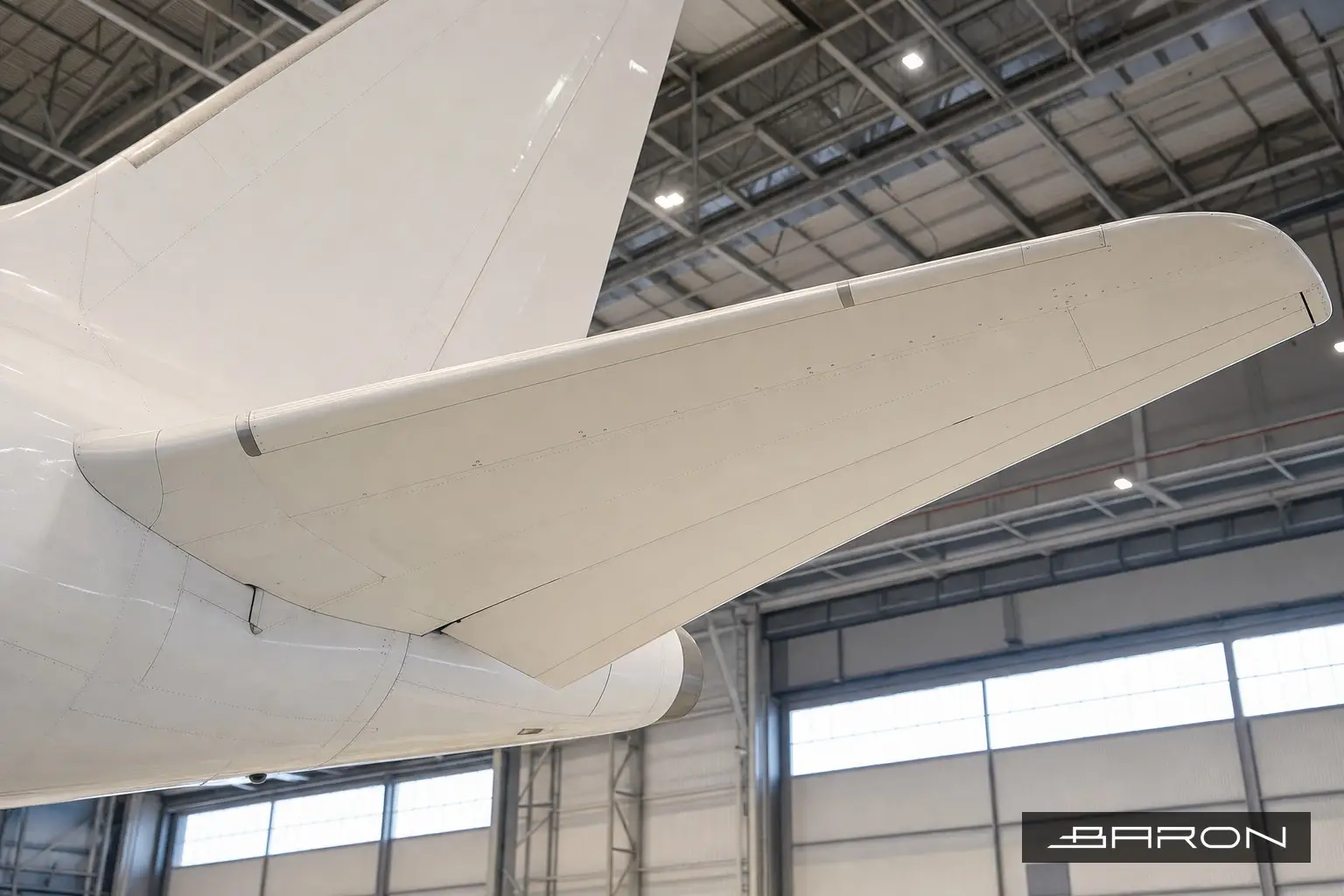
The Airbus elevator is a bonded composite control surface, and like most bonded honeycomb structures it hides its damage on the inside. It is a textbook case of composite and honeycomb inspection, part of the broader aircraft NDT inspection workload on a modern airframe. From the ramp the panel can look perfect while the core underneath is crushed, disbonded, or holding water. That is the problem infrared thermography is built to solve, and it is one of the inspections we run most often at Baron NDT.
An Airbus elevator thermography inspection uses heat, not sound or radiation, to map what is happening between the skins. The technique is fast, it covers large areas in a single capture, and it does not require contact or couplant. For a thin-skin honeycomb panel that is a real advantage over point-by-point methods. For the full method walkthrough, see our complete guide to infrared thermography for composite inspection.
What we are actually looking for
Composite elevators on the A320 and A330 families are built from carbon or glass laminate skins bonded to Nomex or aluminum honeycomb core. The defects that matter are predictable:
- Skin-to-core disbond. The adhesive between skin and core lets go, usually from impact, fatigue, or a previous repair that did not take.
- Water ingress. Moisture migrates into the core through edge seals, fastener holes, or hail damage and sits in the cells. Left alone it freezes at altitude, expands, and drives further disbonding.
- Core crush and node separation. Over-torqued hardware or ground handling impact collapses the cell walls.
- Delamination within the laminate skin itself.
Each of these changes how heat moves through the panel, and that is what the camera reads.
How the method works on a control surface
We use active thermography. A brief, controlled heat pulse goes into the surface, then an infrared camera records how fast each spot cools. Sound, well-bonded structure pulls heat away into the core at one rate. Over a disbond or a pocket of water, heat conducts differently, so that region holds or sheds temperature out of step with its neighbors. The defect shows up as a thermal contrast in the captured sequence.
Flash thermography handles the thin skins on an elevator well because the heat does not have to travel far to reach the bondline. Water sits out clearly because of its high thermal mass. It cools slower than the surrounding dry core and reads as a distinct cool signature that lingers in the image sequence after the flash. This is the same physics we rely on when we run thermography for disbond detection in Airbus rudder bonded skins, and the elevator workflow is closely related.
Procedure and references
Composite control surface inspections are driven by the OEM. The Airbus Nondestructive Testing Manual carries the applicable techniques for elevator and rudder structure, and AC 43.13-1B gives the general acceptable practice for bonded and composite repair verification. We work the inspection to whatever the operator’s approved data calls out, whether that is a scheduled task, a post-repair verification after a bonded patch, or a damage assessment following a reported impact or lightning strike.
Personnel are qualified to NAS 410, and the thermography procedure spells out the heat source, standoff distance, camera frame rate, and the reference standard used to confirm sensitivity before the first part is shot. A known-defect standard or representative panel proves the setup can resolve the smallest disbond the spec cares about before we touch the aircraft hardware.
Why thermography over a tap test or ultrasonics
A coin tap test still has its place, but it is slow, subjective, and depends entirely on the inspector’s ear. Ultrasonic C-scan is accurate but contact-based and tedious across a large curved panel. Thermography images a wide area in one capture, finds water that some pulse-echo setups miss, and leaves a recorded thermal image for the records. We still keep ultrasonic testing in the toolkit for follow-up sizing or when the geometry defeats the camera, so the methods complement each other rather than compete.
For a deeper look at how we apply this on related Airbus structure, see our work on Airbus rudder side panel honeycomb core and our broader Airbus thermography capabilities. If you are new to the method itself, our guide to nondestructive testing covers where infrared fits among the other techniques.
What the operator gets
The deliverable is a clear disposition: location and extent of any disbond, water, or core damage, mapped against the part, with the thermal imagery to back it up. That is what an MRO or operator needs to plan a repair, clear the part, or push a finding back to engineering. Catching a wet or disbonded elevator before it leaves the hangar is the whole point.
Baron NDT is an FAA Part 145 repair station with Boeing and Airbus composite experience. If you have elevators, rudders, or other bonded control surfaces that need a thermographic look, reach out and we will scope the inspection to your approved data.