
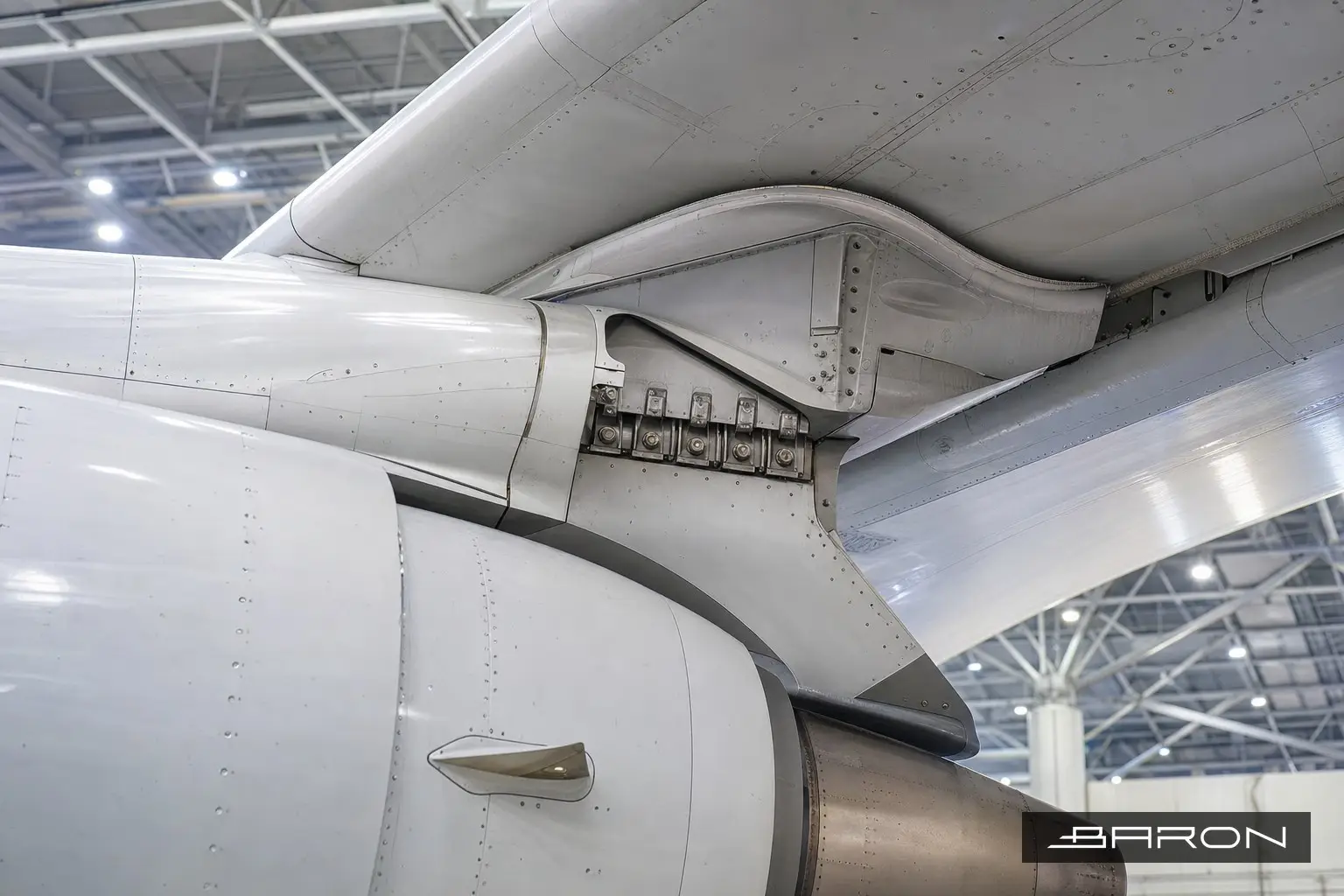
The bolts that tie an engine yoke to the pylon carry some of the most concentrated load on the airframe. They live in a thick, multi-layer joint, they are torqued to high preload, and they are almost impossible to see once the engine is hung. When an OEM inspection document or an airworthiness directive calls for a crack check on these fasteners, pulling every bolt is rarely the answer. Removal is expensive, it disturbs a qualified joint, and it introduces its own risk. Radiography lets us look inside the bolt and the surrounding structure without taking anything apart.
This is one of the recurring pylon jobs we run, and it sits alongside our other pylon fitting inspections. The difference is that eddy current handles the accessible fitting surfaces and bores, while radiography reaches the buried bolt shank and the head-to-shank fillet where fatigue cracks actually start. Yoke-to-pylon bolts are part of the engine-mount load path, so this work belongs to the broader aircraft engine and MRO NDT scope.
Where the cracks start
On a yoke-to-pylon attachment bolt, the high-stress feature is the radius under the head and the first engaged thread. Both are stress concentrations, both see cyclic flight loads, and both are hidden inside the joint. A surface method cannot reach them through the clamped stackup. A radiograph taken at the right angle will, because the crack changes the amount of material the radiation passes through and shows up as a density change on the image.
The catch is geometry. A tight fatigue crack is a thin plane. If the beam is not roughly parallel to that plane, the crack does not produce enough contrast to be reliable. That is why shot angle, not just exposure, drives the whole technique on these bolts.
Technique development
We build a written technique for the specific joint before anyone shoots a part. It defines source, energy, source-to-film distance, the projection angle relative to the bolt axis, and where the image quality indicator sits. The work is done to ASME Section V and ASTM E1742 for the process controls, with the OEM structural repair manual or the AD setting the actual accept and reject criteria.
Real flight hardware almost never gives you a clean single-thickness shot. A yoke joint is a stack of fittings, washers, and the bolt itself, so the effective thickness changes across the frame. We handle that with the energy selection and, where the range is wide, with more than one exposure at different settings so no feature is washed out or starved. Penetrameter placement and a sensitivity check on every shot prove the technique actually resolves the flaw size the spec cares about.
Film, CR, or DR
The choice of medium follows access and turn time. Film still gives excellent resolution on a thick joint and is easy to defend on a records audit. Computed radiography speeds the cycle and tolerates a wider exposure latitude, which helps on a variable-thickness stackup like this one. Digital radiography is the fastest when we can position a panel behind the joint, and the contrast tools make a marginal indication easier to call. We pick the one that fits the airplane in front of us, not a house preference. The trade-offs are covered in our guide to radiographic testing.
Safety and access on the aircraft
Shooting near a hung engine in a hangar means radiation control is part of the plan, not an afterthought. We establish and post the controlled area, sweep it before every exposure, and use survey meters to confirm boundaries. Crew coordination matters because a pylon shot often happens with other trades working the same aircraft. None of this is optional, and it is written into the job before the source comes out of the pig.
Reading the result
A crack under the bolt head reads as a fine dark line that follows the fillet. A thread-root crack shows at the first engaged thread, which is why we index the bolt and document its clocking so a later inspection can repeat the geometry. We grade indications against the OEM limits, not a generic rule, and we keep the images and the technique sheet together so the finding is traceable. When radiography flags something marginal, we will recommend a follow-up, sometimes an eddy current bolt-hole check after removal, to confirm before anyone signs it off.
Why it matters for compliance
Most yoke-to-pylon bolt inspections trace back to an OEM service bulletin or an airworthiness directive, and the records have to prove the method met the intent. Baron NDT runs this work as a Part 145 repair station with NAS 410 certified inspectors, so the technique, the personnel, and the report all line up with what an FAA audit expects. For the bigger picture on how these inspections fit a maintenance program, see our guide to aircraft NDT inspection and our guide to AD compliance. The yoke bolts are also one piece of the wider pylon picture that includes the lower link fittings at the wing.
If you have a yoke-to-pylon attachment bolt inspection coming up and you want it done in place, on schedule, and documented to survive an audit, Baron NDT can build the technique and run it. Call us at 904-304-2907. The same crew also handles the radiographic inspection of the A320 outer wing bottom skin under the pylon, another radiographic task in the pylon-to-wing region.