
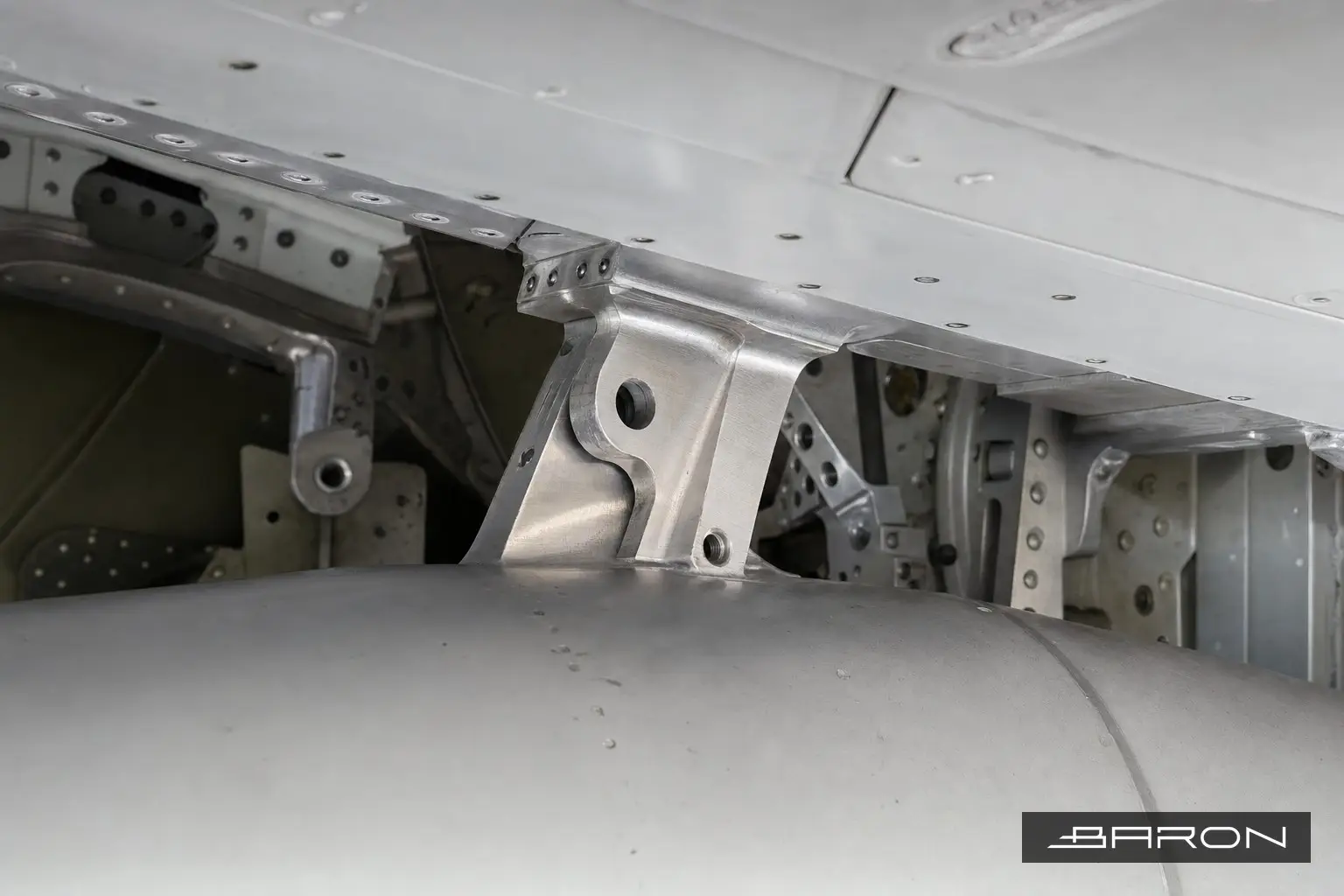
The lower link fittings tie the aft end of the engine pylon to the rear spar of the wing. They carry thrust and vertical load into primary structure, and they live in a fatigue environment that does not forgive missed cracks. When an operator schedules a special detailed inspection on these fittings, eddy current is usually the method of record. This is the work Baron NDT performs on the line and in the hangar, and the detail below is how we approach it. It is one piece of the larger aircraft engine and MRO inspection work that lands on the same heavy checks.
Why these fittings get eddy current and not just visual
The lower link assembly bolts the pylon to the wing through a set of close tolerance fittings, lugs, and bushed bolt holes. The load path concentrates stress at the bore edges, the lug shanks, and the fillet radii where the fitting transitions into the spar attachment. Fatigue cracks start at those exact features, often under a fastener head or inside a bolt hole where you cannot see them. Visual inspection catches a crack only after it has grown out to a free surface. Eddy current finds the crack while it is still tight and subsurface, which is the whole point of a structural significant item inspection.
The OEM NDT manual drives the specifics. On most pylon programs the lower link inspection is called out as a special detailed inspection with a defined method, probe, frequency, and reference standard. We work to that callout, not a generic procedure, because the acceptance limits and the reference notch geometry are part of the engineering basis. For a broader view of how these zone level callouts fit together, see our Ultimate Guide to Aircraft NDT Inspection.
Surface versus bolt hole, two different setups
The lower link area really splits into two inspection problems. Open surfaces, fillet radii, and exposed lug faces get a sliding surface probe. Fastener holes and bushed bores get a rotating bolt hole probe. They use different equipment setups and different reference standards, so we treat them as separate tasks on the same fitting.
For the open surfaces we run high frequency eddy current, typically in the 100 kHz to 2 MHz range depending on the alloy and the depth of interest. A shielded pencil or right angle probe lets us reach the fillet radius and the tight corner where the link bears against the spar fitting. We null on a sound area, set sensitivity on an EDM notch reference standard that matches the part alloy, and confirm the lift off and crack response before we ever touch the part. On aluminum link fittings the surface crack response is sharp and repeatable once the setup is right.
For the fastener holes we pull the bolts as the access dictates and run a rotating scanner with a bolt hole probe sized to the bore. The rotating probe walks down the bore and gives full circumferential coverage, which is the only honest way to clear a hole for corner cracks at the bushing interface. We calibrate on a bolt hole reference standard with a known corner notch, set the rotation speed and feed so the helical pitch keeps coverage tight, and document the scan. This is the same discipline we describe in our overview of eddy current testing.
Access, paint, and the things that slow the job down
The lower link sits in a congested area between the pylon and the wing, so access is half the battle. Some fittings are inspectable in place, others need the link hardware backed off or the bolt removed. Paint and primer matter too. Eddy current tolerates a thin paint film because lift off is part of the setup, but heavy or uneven coating raises the noise floor and can mask a small indication. We confirm the maximum coating thickness the procedure allows and strip locally when the callout requires bare metal at the bore edge.
Bushings add another wrinkle. A fitting with an installed bushing changes the bolt hole inspection because you are now reading through a different material at the bore wall. The OEM manual tells you whether the bushing stays in or comes out, and the reference standard has to reflect that condition. We do not improvise this. If the manual calls for bushing removal, we remove it; if it allows inspection through the bushing, the standard is built to match.
How this connects to the rest of the pylon
The lower link is one node in a full pylon inspection. The same airplane usually has callouts at the upper attach, the front spar, and the track and support fittings, and those often come due together at a heavy check. Baron handles the full set so the records tell a consistent story. We cover the forward end in our writeup on engine pylon front spar fittings, and the rail interfaces in pylon track and support fittings. When the inspection is driven by an airworthiness directive rather than a routine SRM task, the documentation rules tighten up, which we walk through in the guide to FAA airworthiness directive NDT compliance.
Records and personnel
Every scan gets documented to the work order with the procedure number, the reference standard serial, the probe and frequency, and the result by location. Our eddy current personnel are qualified and certified to NAS 410, and the inspection is performed under our FAA Part 145 repair station certificate. That paperwork is what lets an operator close the task with confidence, and it is what an auditor expects to see when the fitting is a structural significant item.
If you have a pylon coming due and the lower link fittings are on the card, Baron NDT can run the eddy current inspection on site or in our shop. Call 904-304-2907 to schedule.