
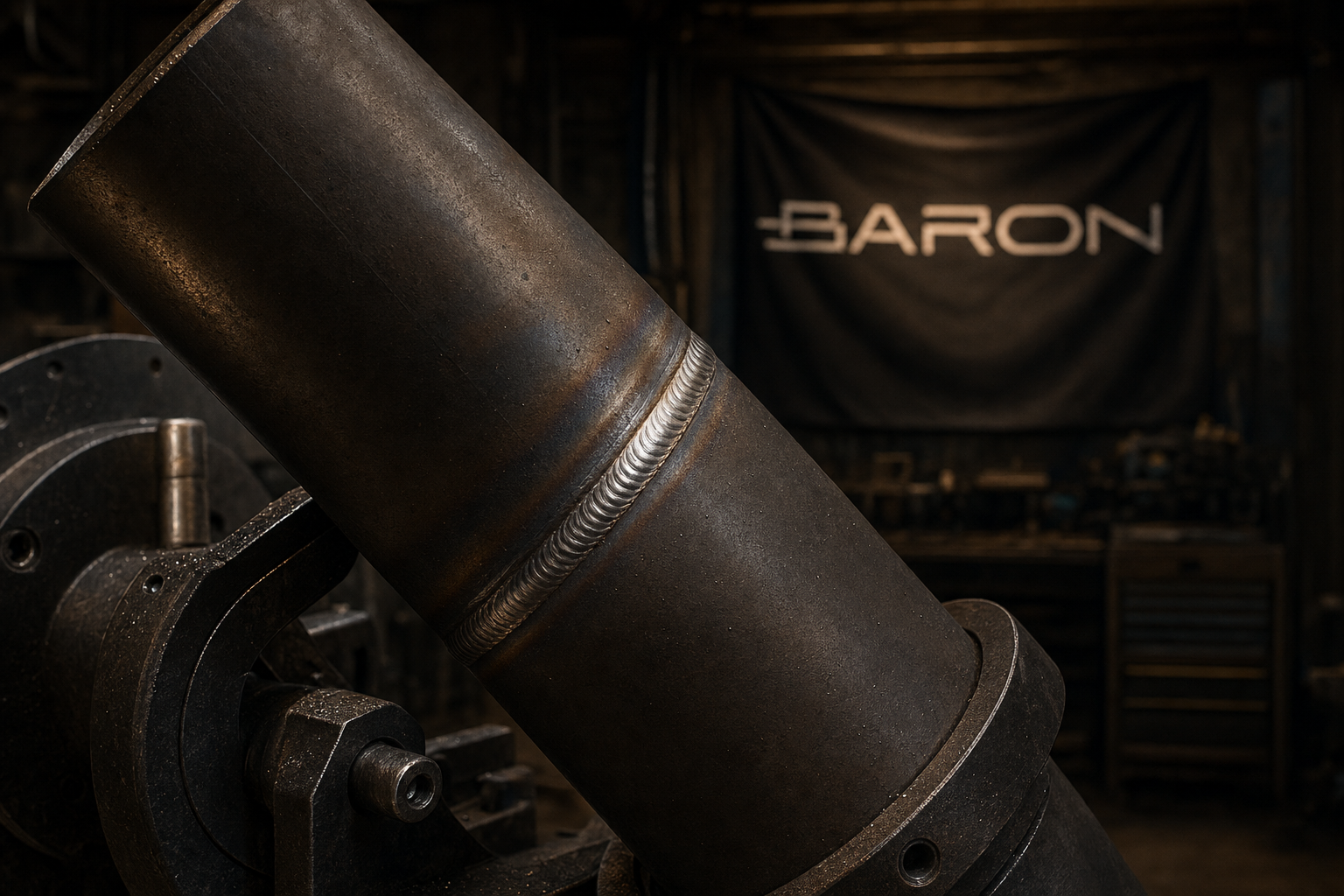
When a fabricator needs proof that a welder can run sound metal in every position a job will ever throw at them, the 6G pipe test is the benchmark. As a Level III and CWI-led shop, Baron Mechanical Weld Testing & Certification Services in Port Arthur, Texas performs independent, third-party welder performance qualification to AWS D1.1 in the 6G position, and this article walks through exactly what that test demands and why it carries so much weight on the Texas Gulf Coast.
What the 6G Position Actually Is
In the 6G position the pipe is fixed at a 45-degree inclined angle and cannot be rotated or moved during welding. Because the coupon is locked at that compound angle, the welder is forced to deposit metal flat, vertical, and overhead within a single weld, transitioning through each orientation as the bead travels around the joint. That combination is precisely why 6G is considered the all-position test that qualifies the widest range of work. A welder who can control the puddle through every clock position of a fixed, inclined pipe has demonstrated command of the most demanding production scenarios, which is why 6G is the gold standard on pipe and the position most often requested by general contractors and EPC firms.
AWS D1.1 Versus ASME IX Context
AWS D1.1, the Structural Welding Code for steel, governs welder qualification for structural carbon steel members, including tubular and pipe-shaped structural elements. It is the code most relevant to buildings, bridges, pipe racks, platforms, and the heavy structural steel that defines industrial construction. ASME Section IX, by contrast, governs welders working on boilers, pressure vessels, and process piping under codes such as B31.3. The two systems share the same fundamental goal of proving operator skill, but they differ in coupon dimensions, essential variables, and acceptance details. A welder may need both credentials depending on the scope, and our shop can advise which qualification path a given project specification requires before any arc is struck. For related guidance, see our coverage of liquid penetrant and magnetic particle testing.
Test Coupon Preparation
A valid qualification begins with a properly prepared coupon. For a 6G structural pipe test we typically use carbon steel pipe with a standard beveled groove, set the root opening and land per the governing welding procedure specification, and fix the assembly so it cannot rotate. The welder deposits the root, fill, and cap exactly as they would in the field, following the same WPS, filler metal, and parameters that production work will use. Documenting that the test conditions mirror the actual procedure is what makes the resulting paperwork defensible if a project ever faces an audit.
Acceptance: Guided Bend Tests and Radiography
AWS D1.1 allows qualification to be proven by mechanical testing or by volumetric examination. The traditional route is the guided bend test, where specimens are machined from the completed coupon and bent around a mandrel to a fixed radius. The convex surface is then examined for open discontinuities, and the bends must show no cracks or other defects exceeding the dimensional limits the code allows. The alternative route is radiographic testing, which uses a film or digital image of the completed weld to reveal internal porosity, slag, incomplete fusion, and cracks without cutting the coupon apart. Many specifications now permit RT in lieu of bends for groove welds, and Baron Mechanical can perform either method in-house, including the related ultrasonic and advanced examination work some clients prefer for thicker sections. For a closer look at how the two acceptance routes compare in practice, see our breakdown of bend testing versus radiography for welder performance qualification.
Visual Acceptance Criteria
Before any bend or shot is taken, every coupon undergoes a visual examination by a Certified Welding Inspector. AWS D1.1 sets clear visual acceptance criteria: no cracks of any kind, complete fusion between weld passes and base metal, acceptable profile with no overlap, undercut held within code limits, and porosity controlled to the allowable frequency and size. The cap must be reasonably uniform, and the root must show full penetration without excessive concavity or burn-through. A weld that fails visual inspection never advances to destructive or radiographic testing, which keeps the process efficient and the documentation clean.
What a 6G Qualification Covers
The reason 6G is so valuable is its breadth. Passing a 6G groove test on pipe qualifies the welder for all positions, which means flat, horizontal, vertical, and overhead on both plate and pipe within the diameter and thickness ranges the code assigns. In practical terms, a welder who qualifies on a representative pipe diameter and wall thickness can cover a wide band of production work without retesting for each new joint configuration. This single-test efficiency is exactly why hiring managers and quality departments lean on the 6G credential as a quick, reliable measure of a welder’s range.
WPS, PQR, and Welder Continuity
Qualification does not exist in a vacuum. Each weld is tied to a Welding Procedure Specification, the recipe that defines how the joint is to be made, and that WPS is supported by a Procedure Qualification Record proving the procedure itself produces sound metal. The welder qualification then demonstrates that a specific operator can execute that procedure. AWS D1.1 also addresses welder continuity, meaning a qualification remains valid only as long as the welder continues using the process within a defined period. We document the test date and process clearly so employers can track continuity and know when requalification is due. That recordkeeping is part of what makes a credential genuinely useful rather than just a piece of paper.
Independent Third-Party Testing on the Gulf Coast
Because Baron Mechanical operates as an independent third-party facility, our results carry credibility that an in-house test cannot match. We have no stake in passing a marginal welder, and our CWI and Level III oversight means the examination is conducted and signed by qualified personnel. Located at 950 FM 365 in Port Arthur, Texas, we serve fabricators, contractors, and industrial clients throughout the Gulf Coast region who need fast, code-compliant welding certification. Whether you are staffing a turnaround, onboarding new hands, or proving your crew to a demanding owner specification, a documented 6G qualification from Baron Mechanical gives you confidence that the welder behind the hood can deliver sound metal in any position the job requires.
To schedule AWS D1.1 6G pipe welder qualification testing, contact Baron Mechanical Weld Testing & Certification Services in Port Arthur, Texas.