
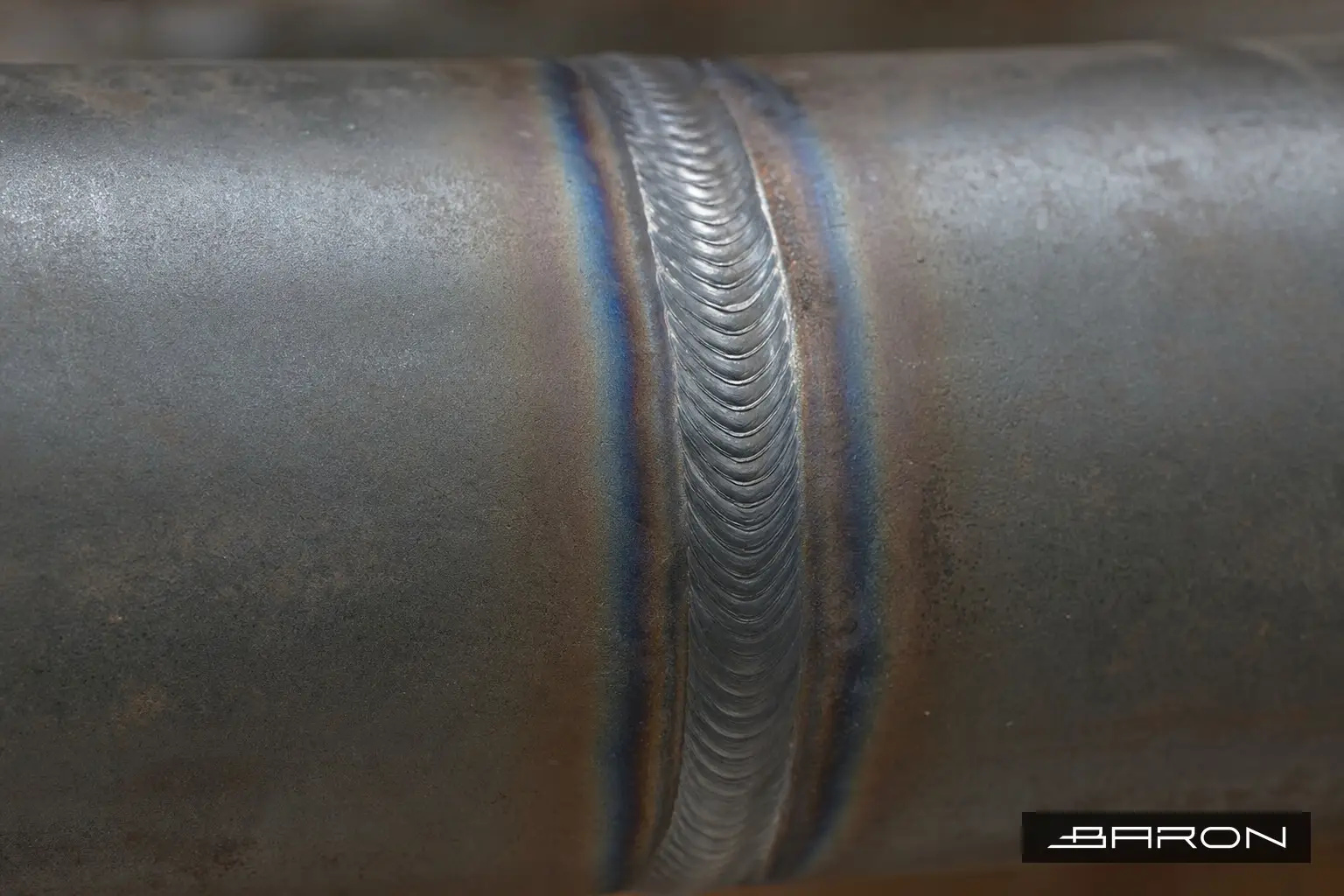
When you inspect a carbon steel butt weld, the method you choose decides what you can find and what you might miss. Phased array ultrasonic testing has changed what is achievable on the shop floor and in the field. This is a practical look at how PAUT performs on carbon steel butt welds, what defects it reliably detects, and where it earns its place over conventional ultrasonic testing and radiography. We apply the same phased array methods on piping, as covered in how phased array ultrasonic inspection ensures pipe integrity.
What PAUT Detects in a Carbon Steel Butt Weld
A properly set up phased array inspection on a 0.5 inch carbon steel butt weld will reliably detect:
- Lack of fusion at the sidewall and between passes
- Lack of penetration at the root
- Slag inclusions trapped between weld beads
- Porosity, both clustered and scattered
- Crack-like indications, including toe and root cracks
- Undercut reflections at the cap
The advantage is coverage. A phased array probe sweeps a range of angles in a single pass, so sidewall lack of fusion that a fixed-angle shear wave probe can walk right past shows up clearly on the sectorial scan.
Calibration Is Where Inspections Succeed or Fail
The detection above only holds if the calibration is right. For carbon steel butt welds, that means setting sensitivity against a representative reference standard and choosing the correct technique for the code in play. Depending on the requirement, you will calibrate using a DAC curve or TCG so amplitude response stays consistent across the full sound path. Skip that step and deep indications read low, which is exactly how real defects get accepted by mistake.
Encoder setup matters just as much. A calibrated encoder ties every indication to a physical position along the weld, so a flaw can be found again, sized, and tracked through repair. That traceability is what separates a defensible inspection from a screen full of unrepeatable signals.
PAUT vs. Conventional UT
Conventional shear wave UT still has its place, and a skilled technician can find plenty with a single-angle probe. But on carbon steel butt welds, PAUT brings three concrete advantages:
- Angular coverage in one pass instead of multiple probe swaps
- Imaging that makes flaw type and location easier to interpret and easier to document
- Permanent records through encoded data, so a third party can review the same scan you did
That record is increasingly what owners and auditors expect. A printed amplitude reading is one thing. An encoded sectorial scan that anyone can reopen is another.
Where Radiography Still Fits
Radiography reads volumetric defects like porosity and slag very well, and many fabrication codes still call for it. Where RT struggles is planar defects oriented unfavorably to the beam, and tight lack of fusion is exactly that kind of defect. PAUT, aimed correctly, is far more sensitive to those planar flaws. On a lot of jobs the right answer is not one or the other but knowing which method the code requires and which method actually finds the defect you are worried about.
The Bottom Line for Carbon Steel Welds
For carbon steel butt welds where weld integrity is critical, phased array ultrasonic testing gives you better detection of planar defects, full angular coverage, and a permanent record that holds up under review. Conventional UT and RT remain useful tools, and the strongest inspection programs use all three deliberately rather than defaulting to one.
Baron NDT provides PAUT, conventional ultrasonic, radiographic, magnetic particle, and penetrant inspection for industrial and aerospace clients. If you have a weld inspection scope and you want it done to code with records that stand up to audit, contact our team.