
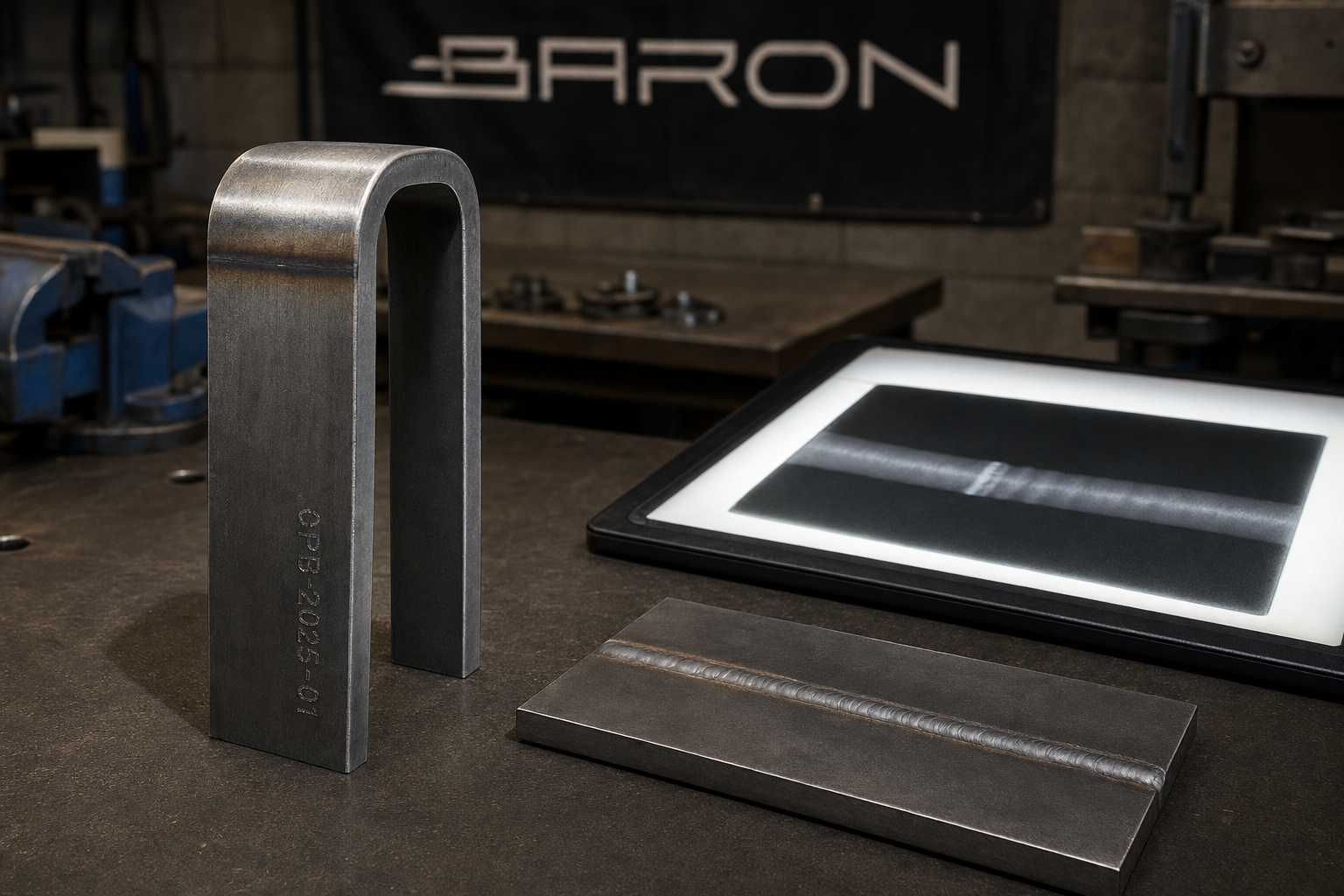
When a welder sits for a performance qualification, the welds they lay down are only half the story. The acceptance method, the way we interrogate that coupon and decide whether the welder passed, is what actually puts a stamp on the record. For decades the default has been the guided bend test, but radiographic testing (RT) is an accepted alternative in several situations. As Level III and CWI-credentialed inspectors, we get asked constantly which one a shop should run. The honest answer is that both prove a welder can deposit sound metal, but they prove it in fundamentally different ways.
What a Guided Bend Test Actually Proves
A guided bend test is a destructive mechanical test. We cut transverse straps from the qualification coupon, then force each strap around a mandrel of a specified radius in a jig. Depending on plate thickness and the code, we pull root bends and face bends on thinner material or side bends on heavier sections. The convex surface goes into tension, and that tension is brutally honest about two things at once: soundness and ductility.
If the weld carries incomplete fusion, slag, porosity beyond the limit, or a hardened brittle zone, the strap opens up a crack on the stretched face. The acceptance criteria are dimensional, measured in the discontinuity length on the convex surface, so the read is objective and repeatable. A bend test does not just hunt for flaws; it confirms the deposited metal and the heat-affected zone have enough toughness to deform without tearing. That combined soundness-plus-ductility proof is something no volumetric method delivers on its own, and it is why bend testing remains the backbone of welder performance qualification at our Port Arthur center.
What Radiography Proves Instead
Radiographic testing is a volumetric, non-destructive method. We pass X-ray or gamma radiation through the welded coupon and capture the image on film or a digital detector. Density variations reveal volumetric discontinuities through the full thickness: porosity, slag inclusions, incomplete penetration, and lack of fusion that presents an exploitable gap to the beam. RT looks at the entire weld length of the coupon at once, not just the two or four straps we would have pulled for bends. If you want the full theory and technique discussion, our complete guide to radiographic testing covers source selection, IQI sensitivity, and image quality.
The trade is what RT does not tell you. A radiograph says nothing about ductility or mechanical toughness. It is a flaw-detection method, and tight planar defects oriented unfavorably to the beam, such as a lack-of-fusion plane lying nearly parallel to the film, can go under-detected. That limitation is exactly why ultrasonic methods sometimes complement or replace RT on production welds, a tradeoff we break down in our look at PAUT versus conventional UT for carbon steel butt welds.
How the Codes Let You Substitute RT for Bends
Both major construction codes recognize RT as an alternative, but with conditions. Under AWS D1.1, a welder qualifying with groove welds may be tested by RT of the test plate or pipe in lieu of the guided bend test, provided the process is not one of the exempted ones (short-circuiting GMAW is the classic exclusion, since RT is poor at catching its characteristic cold-lap fusion defects). When that exclusion applies, the code drives you back to bends. ASME Section IX takes a parallel path: it permits volumetric RT examination of a welder’s qualification coupon as a substitute for mechanical bend testing for most processes, again with the GMAW-short-circuit caveat and specific coupon-length requirements so there is enough sound weld to evaluate. For related guidance, see our coverage of liquid penetrant and magnetic particle testing.
The logic behind both codes is consistent. RT is allowed because, for the processes where it reliably catches the defects of concern, a clean volumetric image is strong evidence the welder controlled the puddle. Where the dominant failure mode is a planar fusion defect that radiography struggles to see, the codes will not let you trade away the bend.
Pros, Cons, and When to Pick Each
Bend testing is cheap, simple, and definitive. The equipment is a press and a jig, the acceptance read is dimensional, and the result is hard to argue with. The cost is the coupon itself: bending destroys it, so there is nothing left to archive or re-examine, and a borderline result cannot be re-shot or re-interpreted.
RT is non-destructive, so the coupon survives intact for the records, for re-review, or for a second opinion. Turnaround can be faster across a batch of welders because you are not machining straps and cycling a press for each one. The downsides are real: RT requires a qualified radiographer, controlled radiation safety, an interpreting Level II or III, and it carries the planar-defect blind spot already noted.
For a shop running standard SMAW or FCAW groove qualifications and wanting the cleanest mechanical proof, bends are usually the right call. For an operation qualifying many welders quickly, where preserving the coupon and avoiding destructive machining matters, RT in lieu of bends is the efficient choice, assuming the process is code-eligible.
Position and Process Considerations
Test position drives the difficulty and the qualified range. A 3G or 4G plate, or a 6G pipe coupon, qualifies the welder for a broad band of positions, and the same coupon can be accepted by either method within code limits. Pipe qualification deserves extra thought: the geometry that makes a 6G pipe weld a demanding test also complicates RT setup and bend-strap removal, so plan the acceptance method before the coupon is welded. Process matters most of all. If the procedure uses GMAW short-circuit transfer, do not plan on RT; the codes will require bends, and trying to qualify that process radiographically invites missed cold-lap defects.
Baron Offers Both, Under One Roof
The practical answer for most clients is that they do not have to choose blindly. At Baron Mechanical in Port Arthur, Texas, we run guided bend testing and radiographic testing for welder performance qualification in the same facility, the same shop that handles AWS D1.1 6G pipe welder qualification testing, with CWI oversight and Level III interpretation on the RT side. We help shops match the acceptance method to the code, the process, and the schedule, then document the result so the qualification holds up to any auditor. Whether you need a fast batch of RT-accepted coupons or the mechanical certainty of a bend, the testing happens in one place at 950 FM 365.
If you are setting up a qualification program and are not sure which acceptance method fits your code and process, talk to our team about a plan that keeps your welders qualified and your paperwork clean.