
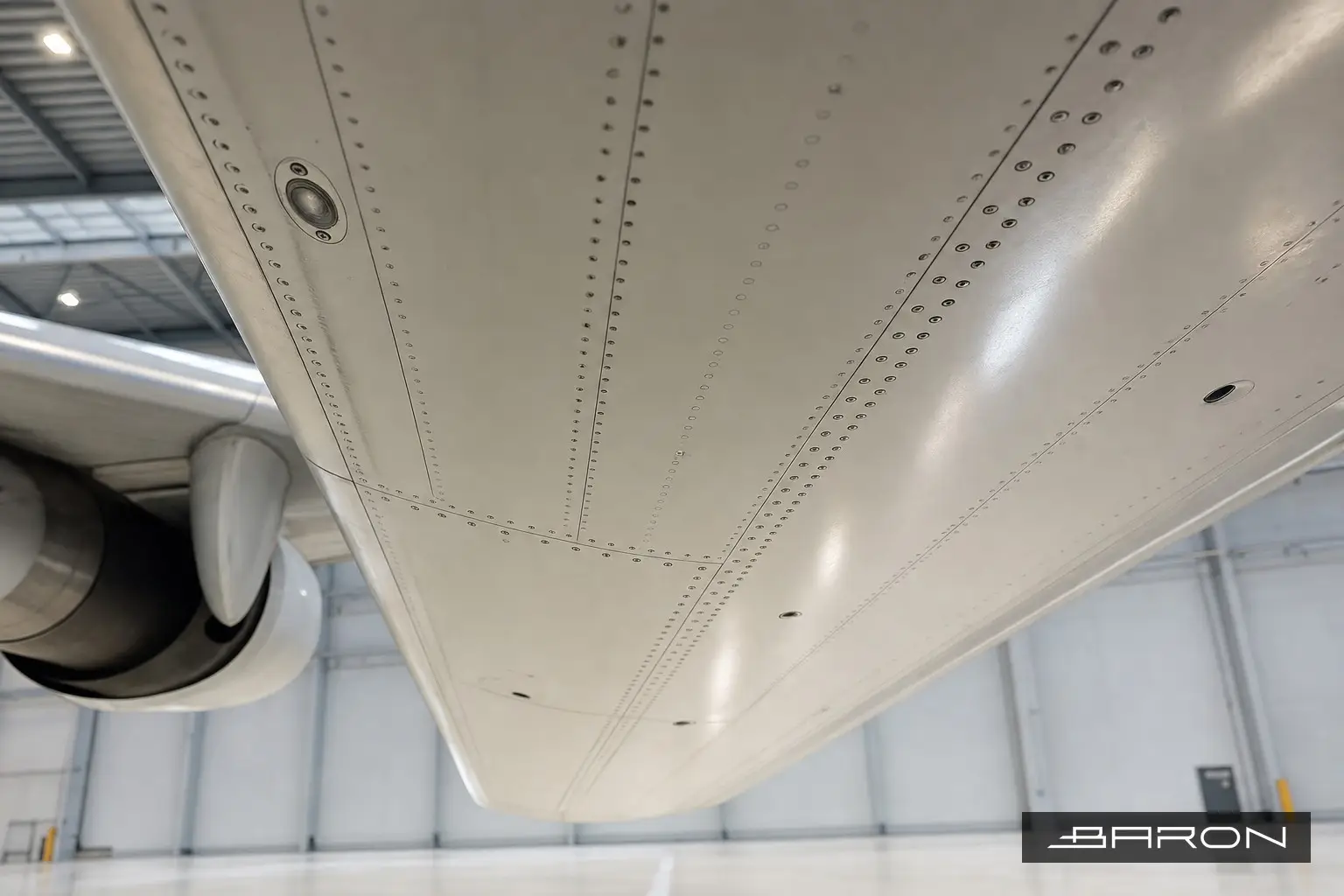
The buttstrap runouts on the A220 wing bottom cover are one of those locations that looks simple on a drawing and turns into a real inspection problem on the airplane. The bottom cover carries the wing’s tension load, and the buttstrap is the splice plate that ties cover sections together at the runout. Fastener rows terminate there, load transfers through a shrinking cross section, and that combination of high stress and edge geometry is exactly where fatigue cracks like to start. Task 57-21-57 in the A220 inspection program calls these areas out for a reason. For the X-ray side of the same family, see our radiographic inspection of outer wing buttstrap runouts.
This is one of the higher-volume phased array jobs that comes through our shop, so here is how we actually approach A220 buttstrap runout phased array inspection, and why the method beats the alternatives at this location. For a deeper task-level breakdown, see our A220 Task 57-21-57 phased array inspection guide.
Why phased array, not conventional UT or eddy current here
The runout is a stacked, multi-layer joint with rows of fasteners. A crack of interest usually grows out of a fastener hole in the cover or the buttstrap and runs toward the next hole or the edge of the strap. With conventional single-element UT you are chasing that crack one angle and one position at a time, and the geometry around a runout changes fast, so you lose coverage between holes.
Phased array fixes that. A linear array driven through a sectorial or linear electronic scan sweeps a range of angles from a fixed footprint, so we image the fastener bore, the faying surface, and the runout taper in one pass. We get a real S-scan and C-scan record instead of a meter reading, which matters when you have to show a crack length and depth, not just a yes or no. For a runout that is hidden under a strap and surrounded by structure, that imaging is the difference between a defensible call and a guess.
Eddy current still has a place on accessible surface and first-layer fastener holes, and we run it where the manual specifies it. But for buried second-layer cracking and for sizing, PAUT is the method that holds up. If you want the broader method comparison, our guide to ultrasonic testing walks through where each UT technique earns its keep.
Setup and calibration
Everything starts with the reference standard. We calibrate on a representative block in the same alloy and thickness as the cover and buttstrap, with EDM notches or side-drilled holes sized to the acceptance criteria in the task. Wedge selection follows the part: we pick the angle range and exit point so the beam covers the runout taper without skip-induced confusion. TCG or DAC is set across the sweep so amplitude response stays honest from the near fastener row to the far edge.
We verify the focal law on the cal block before we ever touch the airplane, confirm the encoder is reading position correctly for the C-scan, and document temperature and couplant. NAS 410 governs the personnel qualification on this work, and the procedure is written to the OEM task and to ASTM E2700 practice for contact phased array. None of that is optional paperwork. A clean, repeatable setup is what lets a second inspector reproduce the call six months later.
Running the scan on the bottom cover
Access drives a lot of the job. The bottom cover is, by definition, on the underside of the wing, so we are working from below, often with the airplane on jacks or with limited clearance. We index the array along the buttstrap runout, keep the encoder coupled, and watch the S-scan live while the C-scan builds the permanent record. Fastener holes show as predictable reflectors. A crack shows up as an indication that breaks out of the bore at an angle and grows with position, which is what separates it from the geometry signal.
When we see something, we do not just flag it. We size it, map it against the fastener row, and capture the data so the engineering disposition has real numbers. The 737 work we describe in our writeup on phased array crack detection per the 737 NDT manual uses the same discipline, and the 737NG lap splice program in AD 2023-13-05 compliance is another good example of imaging buried cracking in a fastened joint.
Records, dispositions, and the bigger picture
A buttstrap runout finding rarely ends with the inspection. The data goes to the operator and, where required, to the OEM for disposition, so the report has to carry calibration records, the C-scan images, indication length and depth, and the exact location relative to station and fastener. We write it so an auditor or a follow-on shop can reproduce every call.
This task sits inside the wider scheduled and AD-driven inspection picture for the airframe. If you are mapping out where structural NDT fits on the airplane, start with our ultimate guide to aircraft NDT inspection, and for the regulatory side see how NDT satisfies directives in our guide to FAA airworthiness directive compliance.
Work with Baron NDT
Baron NDT is an FAA Part 145 repair station with Boeing Conformity Review approval and Level III oversight on phased array. We run A220 buttstrap runout inspections to task 57-21-57 with calibrated, encoded, fully documented PAUT. If you have a bottom cover runout inspection coming up, call us at 904-304-2907 and we will get you scheduled.