

The FAA issued Airworthiness Directive 2026-09-12 (Amendment 39-23334, Docket FAA-2026-1324) for certain Boeing 737 Classic airplanes, covering the 737-100, -200, -200C, -300, -400, and -500 series. It published in the Federal Register on May 13, 2026 and takes effect June 17, 2026. The reason behind it is straightforward and the kind of finding that gets an operator’s attention: cracks were reported in the fuselage skin underneath the aft drain mast. This article walks through what the AD asks for, why the aft drain mast is a known trouble spot, and how Baron NDT performs the required inspections on the airframe.
Why the aft drain mast cracks
The aft drain mast, also called the aft waste water drain mast, is a small external fitting on the lower aft fuselage. It carries fluid overboard, and the cutout and fastener pattern that attach it to the pressurized skin create a stress concentration. Every flight the skin around that cutout sees a pressurization cycle, so the area accumulates fatigue. Add the fluid path and the geometry of the cutout, and you have a classic location for fatigue cracking that starts at a fastener hole or the edge of the cutout and grows in the skin. On an aging fleet like the 737 Classic, those cycles add up, which is exactly the situation an airworthiness directive exists to manage. If you want the broader picture of how the FAA structures these mandates and what compliance looks like, our guide to FAA Airworthiness Directive NDT compliance covers the full process.
What AD 2026-09-12 requires
The AD mandates repetitive inspections of the fuselage skin and structure common to the aft drain mast for any crack or corrosion, plus applicable on-condition actions. The directive points to Boeing Alert Service Bulletin 737-53A1409, Revision 1, dated October 27, 2023, for the procedures and compliance times. Read the required actions closely, because the AD calls out specific NDT methods rather than a generic look-over.
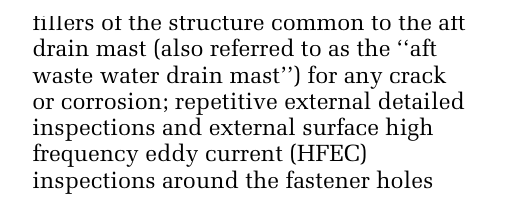
The inspection program has two parts. Inside the airplane, the bulletin specifies repetitive internal detailed inspections around the fastener holes, cutout, channel, and fillers of the structure common to the aft drain mast for any crack or corrosion. Outside the airplane, it specifies repetitive external detailed inspections and external surface high frequency eddy current (HFEC) inspections around the fastener holes and cutout on the fuselage skin common to the aft drain mast. The external HFEC inspection is the part that finds the small surface and near-surface cracks a visual check can miss, especially fatigue cracking that initiates at a fastener hole edge under the mast.
Why high frequency eddy current is the right tool here
Eddy current testing reads the change in an induced electromagnetic field when the probe passes over a discontinuity in a conductive material. On aluminum airframe skin, a crack disrupts the field and the instrument flags it. High frequency eddy current uses a higher excitation frequency to concentrate sensitivity at the surface and the immediate subsurface, which is where drain mast cracking starts. That makes HFEC well suited to scanning around fasteners and along the edge of a cutout, where you need to resolve a tight crack against the geometry of the hole. For a fuller treatment of the method, including array techniques, see our eddy current testing guide.
Technique matters as much as the instrument. The probe has to be matched to the frequency and the fastener geometry, the equipment has to be standardized on a reference standard with known notches before and during the inspection, and the scan pattern around each hole and along the cutout has to be controlled so nothing is skipped. Surface prep counts too. The external skin around the mast carries paint, sealant, and fluid residue, and the inspector has to account for liftoff and any coating thickness so the signal is clean. These are the details that separate a defensible inspection from a checkbox.
How Baron NDT performs the inspection
Baron NDT is an FAA Part 145 repair station, and our eddy current inspectors are certified to NAS-410. On an AD like this one, we run the external detailed inspection and the HFEC scan to the Boeing service bulletin, document the standardization, the probe and frequency used, the areas covered, and any indication with its location and disposition. When an indication shows up, the AD’s on-condition actions come into play, and those route through Boeing repair instructions. We work to the bulletin and the AD, not around them, and the report is written so an operator’s records and the FAA can both trace exactly what was done. For the bigger picture on fitting these inspections into a maintenance program, see our guide to staying compliant with the latest FAA heavy-aircraft ADs without grounding your fleet.
The aft drain mast is one more spot on the 737 where eddy current earns its keep, and it sits alongside other recurring 737 skin inspections we handle. We perform eddy current array inspection of 737 crown skin chem-mill steps and the lap splice work tied to AD 2023-13-05 on the 737NG, so the fleet’s skin-crack program is familiar ground. HFEC also turns up across the wider AD landscape, for example the repetitive HFEC windshield frame inspection on the Airbus A330, which shows how the same method gets applied to very different structures.
Staying compliant
Compliance with AD 2026-09-12 is not a one-time event. The inspections are repetitive, the intervals come from the compliance time tables in the bulletin, and the records have to show the program is being kept current for each affected airplane. Operators flying the 737 Classic should confirm whether their tail numbers fall inside the applicability and get the first inspection scheduled against the effective date. For the full menu of airframe inspections we support across the fleet, our aircraft NDT guide ties the methods and structures together in one place.
If you operate or maintain 737 Classic airplanes affected by AD 2026-09-12, Baron NDT can perform the external detailed and HFEC inspections of the aft drain mast skin to the Boeing service bulletin and return inspection records ready for your compliance file. Reach out to our Jacksonville aviation team to schedule.