

On May 29, 2026 the FAA published a new final rule airworthiness directive that puts a recurring eddy current inspection on the books for a large slice of the in-service Airbus A330 fleet. It is AD 2026-10-13 (Amendment 39-23353, Docket No. FAA-2025-3988), and it becomes effective on July 6, 2026. If you operate an affected A330, this is not a one-time check. It is a repetitive special detailed inspection that has to be planned into your continued airworthiness program and tracked for the life of the airplane.
This article walks through what the AD actually says, which airplanes it covers, and what the high frequency eddy current (HFEC) inspection involves on the central windshield frame. We work these inspections on transport-category aircraft as an FAA Part 145 repair station, so the goal here is to translate the regulatory language into the practical inspection it describes. It is also one of several 2026 directives we cover in our broader guide to staying compliant with the latest FAA heavy-aircraft ADs without grounding your fleet.

What prompted the AD
The FAA action follows EASA AD 2025-0071, dated March 31, 2025, which is the mandatory continuing airworthiness information (MCAI) behind this rule. EASA is the Technical Agent for the State of Design, and the FAA adopted its requirements for U.S.-registered airplanes.
The root cause is a manufacturing issue, not in-service fatigue from normal operation. An incorrect shot peening application was implemented in production on the affected central windshield frames. Shot peening introduces a compressive residual stress layer that resists crack initiation. When it is applied incorrectly, the fatigue life of the part can come out lower than the certified value. The FAA states plainly that this condition, if left unaddressed, could adversely affect the structural integrity of the airplane. The structure in question falls under ATA Code 53, Fuselage.
Which airplanes are affected
The AD applies to specific Airbus A330 models certificated in any category, as identified in EASA AD 2025-0071:
- A330-201, -202, -203, -223, and -243 (A330-200 series)
- A330-223F and -243F (A330-200 Freighter)
- A330-301, -302, -303, -321, -322, -323, -341, -342, and -343 (A330-300 series)
- A330-841 (A330-800)
- A330-941 (A330-900)
The FAA estimates the rule reaches 85 airplanes of U.S. registry. The applicability is by individual airplane configuration, so the first compliance step on any tail is to confirm whether it is in the affected group using the effectivity in EASA AD 2025-0071 rather than assuming all A330s are in or out.
What the AD requires
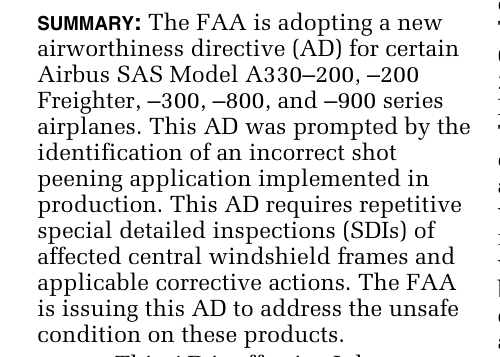
The requirement language is direct. Paragraph (g) of the AD requires operators to comply with all required actions and compliance times specified in, and in accordance with, EASA AD 2025-0071, with the FAA exceptions noted in paragraphs (h) and (i). In plain terms, the EASA AD is the work instruction and the FAA AD makes it mandatory for U.S. operators.
The required action is a repetitive special detailed inspection (SDI) of the affected central windshield frame, accomplished as a high frequency eddy current (HFEC) inspection for cracking of the windshield central lower framing fillet radius on both the left-hand and right-hand sides. The inspection repeats at the interval defined in the source documents, which is why it has to live in your tracking system and not just on a single work card.
HFEC is the right method for this feature. The crack the AD is hunting initiates at a fillet radius, a stress concentration where a thin, tightly controlled eddy current field can resolve a surface or near-surface crack that a visual check would miss. A higher inspection frequency keeps the probe field shallow and sharpens sensitivity to tight surface-breaking indications. If you want a deeper background on how the method works on aluminum airframe structure, our guide to eddy current testing (ET and Eddy Current Array) covers the fundamentals, and eddy current crack detection on aircraft shows why it is the workhorse for this kind of fatigue cracking.
Corrective action if cracking is found
The AD does not stop at detection. It carries applicable corrective actions. The FAA modified the EASA repair language through the exceptions in paragraph (h): where EASA AD 2025-0071 refers to contacting Airbus for repair instructions, the FAA requires that if any cracking is found on an affected part, the cracking must be repaired before further flight using a method approved by the Manager, AIR-520, Continued Operational Safety Branch, FAA; or EASA; or Airbus SAS’s EASA Design Organization Approval (DOA). The practical takeaway is that a crack finding grounds the airplane until an approved repair is done, so the inspection result needs to be clear, documented, and defensible.
This is where inspection quality matters as much as scheduling. A repetitive SDI is only as good as the technician, the technique, and the records behind it. A fillet radius HFEC scan demands the correct probe, a reference standard that represents the part geometry, and a calibrated setup, all documented to the procedure. Baron NDT runs the same discipline on comparable fatigue-critical features, for example our eddy current inspection of DC-10 and MD-11 pylon fillet radii, where the crack also starts at a radius and the method has to be tuned to that geometry.
Compliance timing and what to do now
The AD is effective July 6, 2026. The Director of the Federal Register approved the incorporation by reference of the EASA material as of that date. The compliance times for the initial and repeat inspections are the ones specified in EASA AD 2025-0071, so the first move is to read the source AD against each affected tail, establish the initial inspection threshold, and set the repeat interval in your maintenance tracking. The FAA cost estimate of roughly 4 work-hours per airplane is for the inspection labor only and does not include any on-condition repair.
A clean path to compliance looks like this:
- Confirm applicability by airplane configuration against EASA AD 2025-0071.
- Establish the initial inspection threshold and the repetitive interval for each affected tail.
- Perform the HFEC special detailed inspection of the left-hand and right-hand windshield central lower framing fillet radius to an approved procedure, with qualified personnel and the correct reference standard.
- If cracking is found, hold the airplane and obtain an FAA, EASA, or Airbus DOA approved repair before further flight.
- Document the inspection, set the next due interval, and keep the records audit-ready.
How Baron NDT helps operators stay AD-compliant
Baron NDT is an FAA Part 145 repair station and an SDVOSB that performs eddy current and special detailed inspections on transport-category aircraft, including widebody Airbus and Boeing structure. We have the procedures, the personnel qualified to NAS-410, and the reference standards to run a repetitive HFEC inspection of the A330 central windshield frame fillet radius and to document it so it stands up to an audit. We can mobilize to the aircraft and fold the repeat interval into your continued airworthiness tracking so the recurring requirement does not slip.
If you want the bigger picture on directive-driven inspections, see our complete guide to FAA Airworthiness Directive NDT compliance and the broader ultimate guide to aircraft NDT inspection. This A330 rule also rhymes with prior HFEC-driven directives we support, such as the Boeing 737NG lap splice inspection for AD 2023-13-05, where high frequency eddy current is again the called-out method.
If you operate affected A330s and need the windshield frame SDI performed or planned before the July 6, 2026 effective date, contact Baron NDT and we will scope it to AD 2026-10-13 and EASA AD 2025-0071.
Source: FAA Airworthiness Directive 2026-10-13, Amendment 39-23353, Federal Register Vol. 91, No. 103, May 29, 2026 (FR Doc. 2026-10802); referencing EASA AD 2025-0071, dated March 31, 2025. This article is general information and not a substitute for the official AD and its referenced service information.