
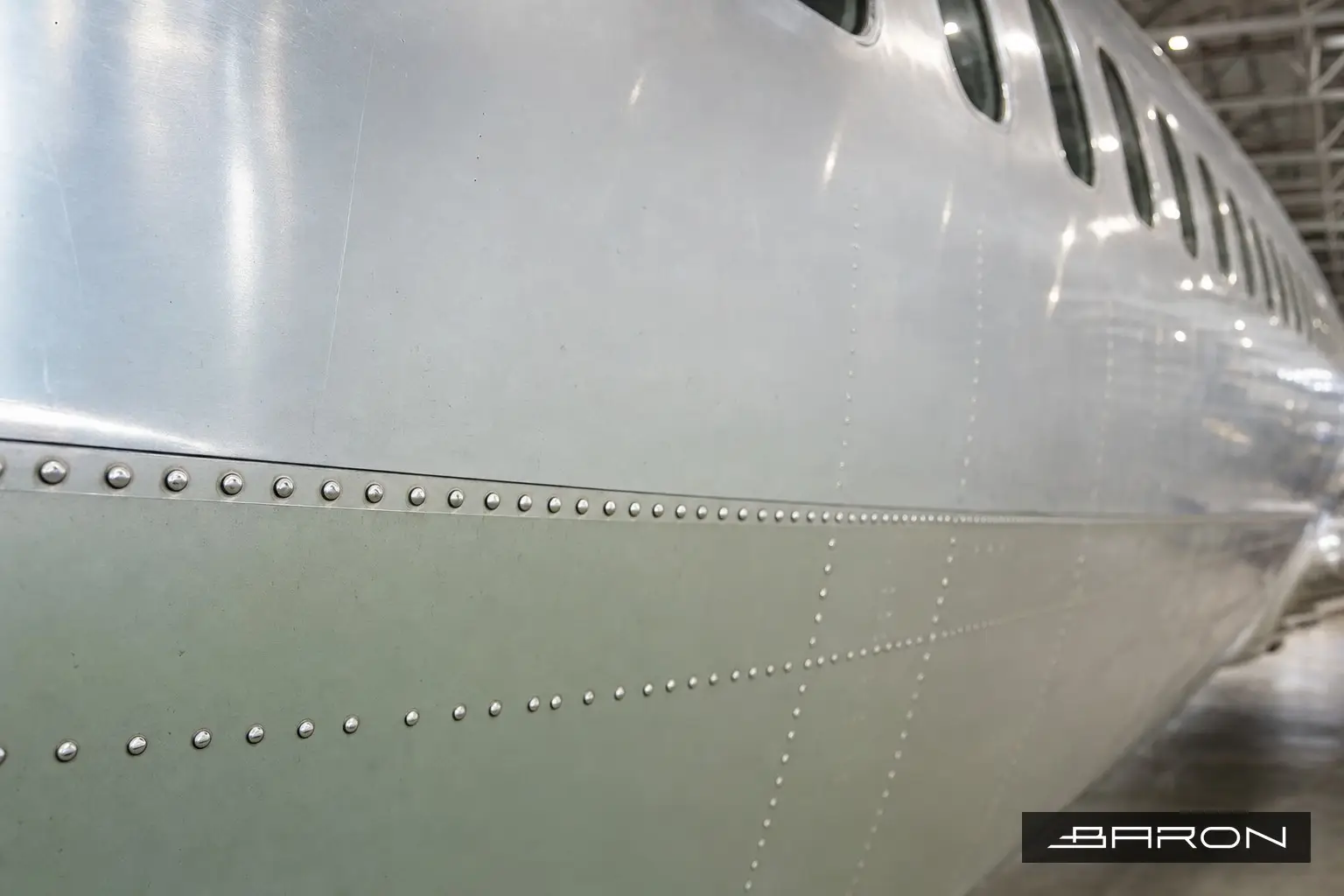
Longitudinal skin splices are one of the busiest fatigue zones on a pressurized fuselage. Every cabin cycle loads the hoop stress straight through the fastener rows that join adjacent skin panels, and after enough cycles that load finds the edge of a hole and starts a crack. On older Boeing structure the concern is multiple site damage, where small cracks grow at several fasteners along the same row and eventually link up. That is the failure mode special detailed inspection is written to catch, and eddy current array is the method that catches it fast.
Baron NDT performs eddy current array skin splice Boeing inspections as a Part 145 repair station, working to the operator’s approved Boeing NDT Manual procedure and NAS 410 certified personnel. The goal is simple to state and hard to do well: find a fatigue crack hiding under a fastener head or at the edge of a hole, through paint and primer, without pulling a single rivet.
Why the longitudinal splice cracks
A longitudinal splice runs fore and aft along the fuselage, joining skin panels with rows of countersunk fasteners. Internal pressure puts the splice in tension on every flight. The critical cracking starts at the faying surface, at the upper rivet row, where the load transfer is highest and the crack is least visible from outside. By the time a crack is long enough to see with a borescope or a flashlight it is well past the point where the inspection should have flagged it.
This is the same family of structure behind the aging aircraft program and several airworthiness directives. If you want the regulatory side of how these inspections get mandated and documented, our guide to FAA airworthiness directive NDT compliance walks through reading an AD and selecting the method. The lap joint counterpart is covered in our writeup on Boeing 737NG lap splice NDT for AD 2023-13-05.
Why eddy current array over single-probe ET
Conventional eddy current with a single sliding or pencil probe works, and Baron still uses it for spot checks and small access areas. The problem on a long splice is coverage. A single probe inspects one narrow track at a time, so a full splice means dozens of overlapping passes and the result depends heavily on the operator holding a clean line. Miss the edge of a hole by a few thousandths and you can walk right past the crack.
An eddy current array probe carries many coils across its footprint and electronically multiplexes them, so one pass covers a wide band with built in overlap. The instrument builds a C-scan style map of the surface, which gives a permanent image you can review, archive, and compare flight to flight. For a fastener row that means consistent coverage of every hole edge in far fewer passes, with the data captured rather than called out verbally. The fundamentals of the method are laid out in our guide to eddy current testing, and the crack detection physics in how eddy current finds cracks on aircraft.
How Baron runs the inspection
The work follows the operator’s approved Boeing NDT Manual procedure for the specific airplane and zone, in the 53-30 structures family. The general sequence is consistent across splices.
- Clean the splice and confirm the paint and primer thickness is within the procedure’s lift-off allowance. Excess buildup is sanded or accounted for in calibration.
- Calibrate the array on the reference standard called out in the procedure, with EDM notches at the specified depth, and set the alarm threshold off those notches.
- Index the array along the upper fastener row, holding orientation so each coil track crosses the hole edges where cracking initiates.
- Watch the impedance plane and the C-scan in real time, mark any indication that breaks threshold, and rescan it with a single probe to confirm and size.
- Document every relevant indication with location, length, and the data file, then disposition against the procedure’s accept and reject criteria.
Personnel are certified to NAS 410 and the work is logged under the repair station quality system so the records hold up on audit. The same disciplined approach Baron uses for the 737 crown skin chem-mill step inspection carries straight over to splice work, since both depend on tight calibration and clean array tracking over a fastened joint.
Where it fits in the airplane
Skin splice inspection is one piece of a larger structures program. Operators schedule it alongside lap joint, frame, and stringer checks during heavy maintenance. For the full picture of how methods map to airframe zones, see our guide to aircraft NDT inspection, which ties the individual task articles together.
If you operate Boeing narrowbody or widebody fleets and need eddy current array coverage on longitudinal splices, lap joints, or related fuselage structure, Baron NDT can support it at your line or in our shop. Call 904-304-2907 to talk through the scope and the applicable procedure.