

The FAA has issued Airworthiness Directive 2026-10-15 for a large slice of the Airbus A320 family, and it lands squarely in eddy current territory. The directive was prompted by a manufacturing deviation found during a review of the cold working process on the assembly line, and it requires repetitive special detailed inspections along with rototest or high frequency eddy current inspection of the affected fasteners and fastener holes. If you operate or maintain A318, A319, A320, or A321 airplanes, this is a recurring inspection task that needs qualified people and calibrated equipment, and it is exactly the kind of work Baron NDT performs as an FAA Part 145 repair station. It is also part of the wider 2026 wave we break down in our guide to staying compliant with the latest FAA heavy-aircraft ADs without grounding your fleet.
What AD 2026-10-15 covers
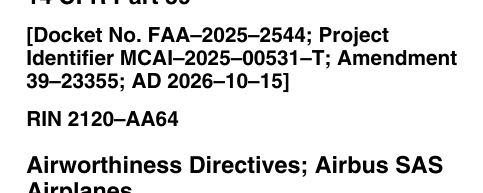
The directive is published in the Federal Register dated May 29, 2026 (Amendment 39-23355, Docket No. FAA-2025-2544, Project Identifier MCAI-2025-00531-T) and becomes effective July 6, 2026. It applies to a broad set of Airbus SAS models: certain A318-111, -112, and -122 airplanes; A319-111, -112, -113, -114, -115, -131, -132, and -133 airplanes; A320-211, -212, -214, -216, -232, -233, -251N, -252N, -253N, -271N, -272N, and -273N airplanes; and A321 series airplanes including the -211, -212, -213, -231, -232, -251N, -252N, -253N, -271N, -272N, and the NX variants.
What the AD actually requires
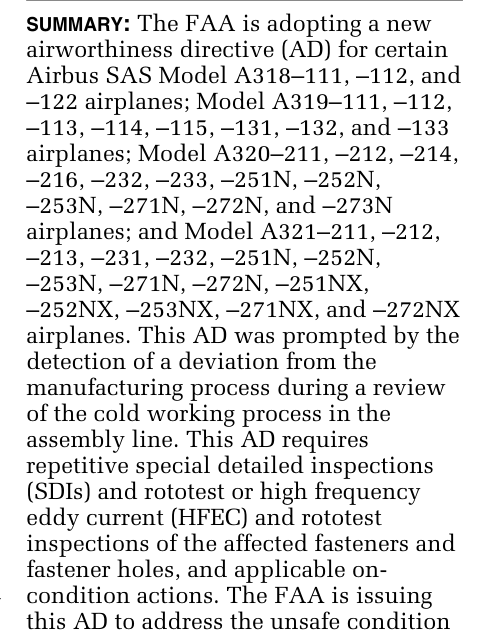
The summary language is direct. The AD requires repetitive special detailed inspections (SDIs) and rototest or high frequency eddy current (HFEC) and rototest inspections of the affected fasteners and fastener holes, plus applicable on-condition actions. In plain terms, you inspect the fasteners and the holes they sit in, you do it on a repeating schedule, and you act on whatever the inspection finds. The FAA issued the directive to address the unsafe condition created when the cold working step did not perform as intended.
Why cold working matters, and why a deviation is a problem
Cold working a fastener hole is a deliberate process. A mandrel is drawn through the hole to plastically expand the surrounding material, which leaves a ring of beneficial compressive residual stress around the bore. That compressive layer is what slows fatigue crack initiation and growth at the hole, where stress concentrates every time the airframe is pressurized and flexed. It is a fatigue life multiplier, and the structure is sized with that benefit in mind.
When the cold working process deviates, the intended compressive stress may not be fully present. The hole then behaves more like an as-drilled hole under cyclic load, and the margin against fatigue cracking shrinks. That is the unsafe condition the AD targets. Because the issue traces back to how the holes were made rather than to a single in-service event, the FAA mandates repetitive inspection so any cracking that does start is caught before it grows to a critical size.
Rototest and HFEC: how the inspection finds the cracking
Two eddy current approaches do the work here, and they are complementary. Rototest is a rotating-probe bore eddy current method. A small probe spins inside the open fastener hole and sweeps the full bore surface, so a crack growing out of the hole wall produces a clear, repeatable signal as the probe passes over it. It is the right tool for the inside of the hole, where cold working cracks tend to originate.
High frequency eddy current covers the surface around the fastener and the fastener head region. Running HFEC at the higher frequencies keeps the eddy currents shallow and concentrated near the surface, which sharpens sensitivity to tight surface and near-surface cracks emanating from the hole edge. Used together, rototest inside the bore and HFEC around it give coverage of both the hole wall and the surrounding skin, which is why the AD pairs them. If you want the fundamentals of the method, our guide to eddy current testing and eddy current array walks through the physics and the probe types.
Doing this correctly is not just owning the instrument. The probe has to match the hole diameter, the reference standard has to carry representative notches, the scan has to be calibrated and documented, and the technician has to be qualified to NAS-410 for the method. A special detailed inspection on a fastener hole leaves no room for a sloppy setup, because the flaw you are hunting is small by design.
How Baron NDT supports A320 operators on this AD
Baron NDT is an FAA Part 145 repair station that performs eddy current inspection on transport aircraft structure, including rototest of fastener holes and HFEC of skins and fittings. We set up the reference standards, qualify the technique for the specific fastener and hole geometry, run the repetitive inspections on the schedule the AD calls for, and document the results for your records and your compliance file. When an inspection turns up an indication, we report it cleanly so your engineering and maintenance team can move straight to the on-condition actions.
This AD follows a pattern we are seeing across the fleet. We recently covered the Airbus A330 windshield frame HFEC directive and the Boeing 737 Classic aft drain mast HFEC directive, both of which lean on the same eddy current discipline applied to different structure. For the bigger picture on building and tracking an AD compliance program, see our guide to FAA airworthiness directive NDT compliance, and for how these tasks fit into a full airframe inspection plan, our ultimate guide to aircraft NDT inspection ties the methods together.
Plan the repetitive inspection now
AD 2026-10-15 is effective July 6, 2026, and the inspections are repetitive, so this is a standing item on the maintenance plan rather than a one-time check. Operators who line up qualified eddy current support early keep the airplane on schedule and keep the compliance record clean. If you maintain affected A318, A319, A320, or A321 airplanes and need the SDI plus rototest and HFEC inspection performed, Baron NDT is ready to support the work. Reach out and we will scope the inspection to your fleet and your schedule.